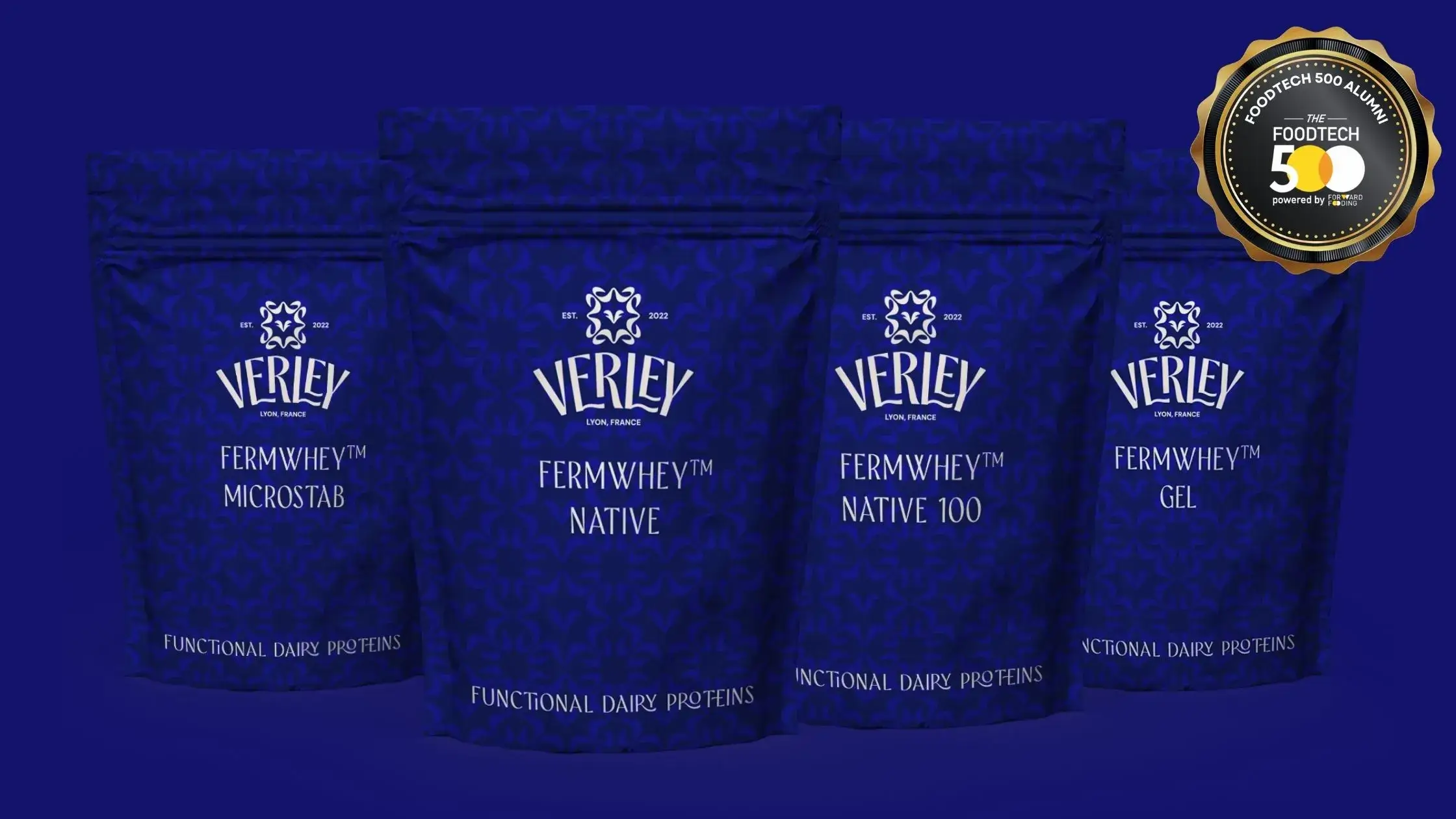
The global food system faces an urgent challenge: feeding a growing population with sustainable, protein-rich options that don’t exhaust our planet’s resources. Traditional dairy production, while vital, contributes significantly to environmental impact. Stepping into this crucial gap, Verley, an innovator in the AgriFoodTech space, is rapidly scaling its precision fermentation technology for functional dairy proteins, announcing significant production milestones and a strategic push towards commercialization in the US by 2026.
Founded in 2022, Verley is tackling one of the food system’s most pressing challenges: the growing protein gap is expected to increase from 50 to 100M tons (dry) from 2030 to 2050 (GIRA).
As global demand surges and environmental pressures mount on conventional agriculture, Verley’s precision-fermented whey proteins offer a scalable, sustainable alternative that doesn’t compromise on functionality or nutrition.
What sets Verley apart in the crowded alternative protein landscape? A laser focus on B2B ingredient solutions, a strategic emphasis on whey over casein, and an impressive regulatory track record that includes securing FDA GRAS “No Questions” Letter status in less than three years since founding.
We asked Verley’s co-founders, Stéphane Mac Millan and Hélène Briand, to share how the company is navigating the precision fermented sector and the ever-evolving regulatory landscape.
This interview has been edited for clarity and concision.
Forward Fooding: How do you plan to navigate evolving regulatory landscapes in key markets to ensure the timely and broad commercialization of your functional dairy proteins?
Stéphane Mac Millan and Hélène Briand: Verley takes a proactive, science-driven approach to regulatory strategy. Our recent GRAS “No Questions” Letter from the FDA demonstrates our ability to meet rigorous safety standards quickly, less than three years after founding the company. We prioritize markets based on commercial demand and regulatory readiness, with dossiers already underway for additional key geographies in Europe, Asia, and the Middle East.
Our in-house expertise, combined with external regulatory advisors and a scientific board, ensures that we can adapt swiftly as policies evolve while maintaining full compliance and transparency.
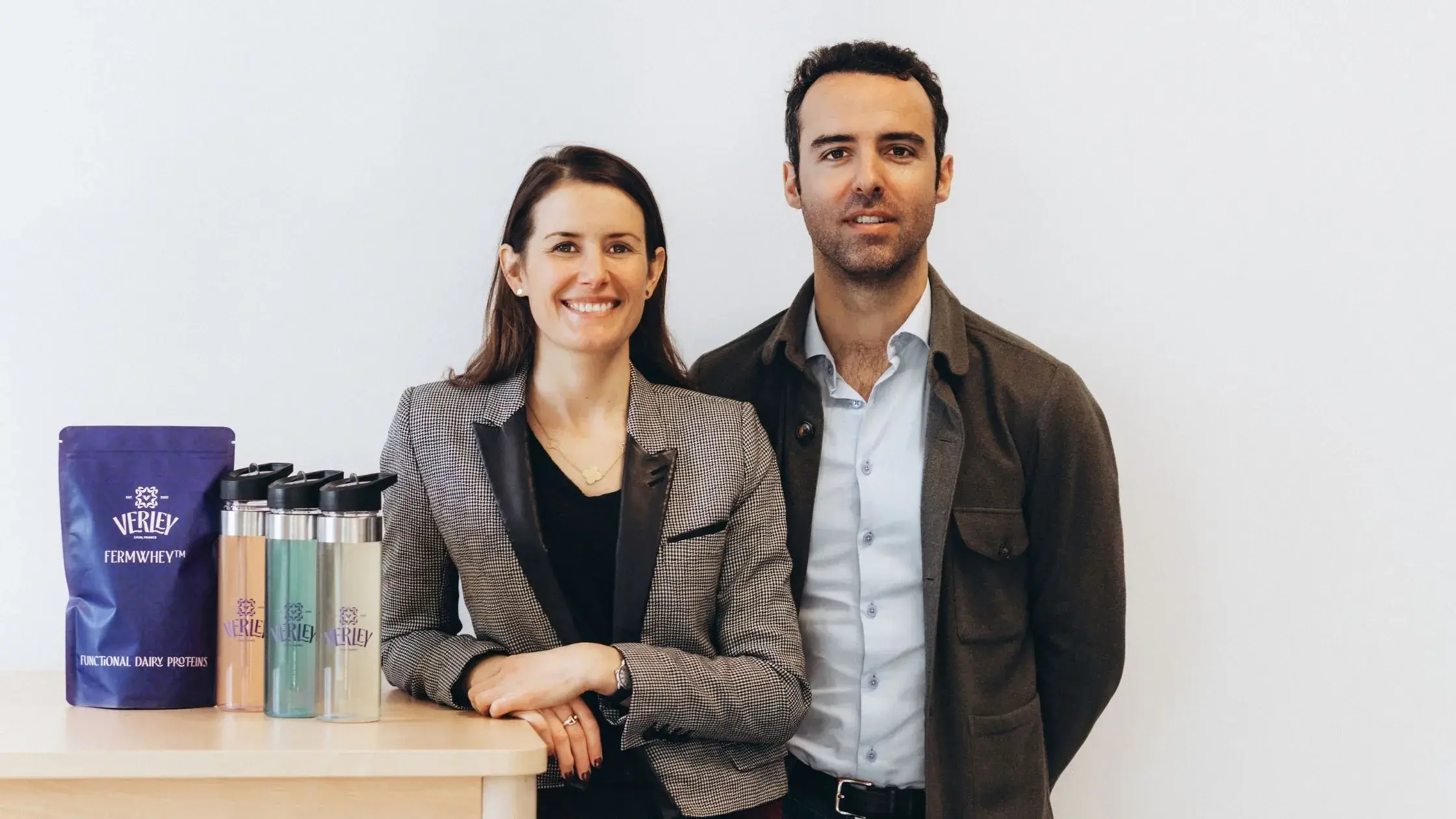
Verley Founders: Stéphane Mac Millan and Hélène Briand
The Power of Partnership in Meeting Sustainability
Verley was established to provide a sustainable and scalable solution to the current protein gap by complementing existing supply chains and helping build a food system that can feed 10 billion people.
Forward Fooding: What are the specific challenges and opportunities you foresee in integrating your precision fermentation-derived whey proteins into existing large-scale food manufacturing processes?
Stéphane Mac Millan and Hélène Briand: The key challenge is achieving consistency and performance at scale while matching the expectations of manufacturers accustomed to conventional dairy ingredients.
That’s why we’ve developed a range of functionalized proteins specifically designed to integrate seamlessly into real-world formulations: from ready-to-drink beverages to medical nutrition. Our proteins are tested for industrial robustness, including solubility, thermal stability, and acid resistance. We work closely with partners to support formulation, process validation, and scale-up, turning innovation into operational reality.
Stéphane and Hélène believe that “partnerships with large corporations are essential to scaling impact.” For them, “At Verley, we see collaboration not just as go-to-market support, but as a way to accelerate innovation, align with industrial realities, and drive systemic change in how we produce and consume protein. A more sustainable food system will be built together, not in isolation.”
Strategic Positioning: Learning from the Landscape

Forward Fooding: Let’s talk about positioning. When you look at the established dairy industry, where exactly does Verley fit into that ecosystem?
Stéphane Mac Millan and Hélène Briand: Verley doesn’t position itself as an “alternative” to dairy. We build on it. Our precision-fermented whey proteins are complementary ingredients that bring the performance and familiarity of dairy into new food formats. We’re not trying to mimic milk; we’re expanding what’s possible with it.
Our FermWhey™ range includes native and functionalized dairy proteins produced without animals, designed for high-performance nutrition. From improved solubility and gelling to enhanced leucine delivery, we tailor our proteins to meet real formulation and industrial needs. That’s where our functionalization platform comes in: it allows us to unlock new functionalities beyond what’s found in nature, helping manufacturers deliver clean-label, digestible, and compact nutrition solutions, especially relevant in the context of GLP-1, medical, and active nutrition markets.
We see ourselves as part of the future of dairy, working with food and nutrition leaders to build a more sustainable, functional, and resilient protein ecosystem.
Forward Fooding: What significant external market shifts or competitive developments have you observed recently that could impact your strategic direction, and how are you adapting?
Stéphane Mac Millan and Hélène Briand: The convergence of performance nutrition, GLP-1 adoption, and active lifestyle trends is reshaping protein demand, particularly for clean-label, functional, and high-leucine ingredients. At the same time, volatility in dairy supply chains and whey pricing is creating new space for complementary solutions.
Verley is adapting by focusing on segments where conventional whey falls short: from stability in acidic RTDs to advanced gelling needs in functional foods. We’re also monitoring regulatory and consumer shifts to remain agile and opportunity-driven, as demonstrated by our capacity to develop new ingredients: we are the first company in our field to introduce a full range of protein ingredients.
Forward Fooding: How do you continuously assess and respond to consumer perceptions and industry trends regarding alternative proteins, especially as it relates to B2B ingredient supply?
Stéphane Mac Millan and Hélène Briand: We hear some deception towards plant-based alternatives and increased demand for clean-label, high-performing, and digestible proteins. Our proteins are not positioned as “alternatives” but as complementary, animal-free dairy ingredients that meet consumer expectations on taste, nutrition, and sustainability.
We continuously monitor trends through market research, customer feedback, and scientific publications, and we support our B2B clients with insights to develop consumer-facing narratives that are transparent, science-backed, and regulatory-compliant.
Forward Fooding: Looking at the landscape of failed startups in your specific market segment, what are the key lessons you’ve learned, and how is your strategy different?
Stéphane Mac Millan and Hélène Briand: In the innovative dairy and fermentation-derived protein space, many startups have struggled because they target consumer-facing products directly or attempt to mimic casein-heavy dairy structures that demand very tight cost and sensory margins.
From those cases, we draw two key lessons: First, focus on B2B, not B2C. Many failures came from trying to build a consumer brand while simultaneously scaling novel technology. At Verley, we remain purely B2B — supplying ingredient-level solutions to food & beverage manufacturers. This lets us concentrate on technology, regulatory robustness, process scale-up, and functional performance, while our customers focus on branding, sales, and distribution.
Second, whey over casein is a strategic choice. Casein-based formulations are notoriously difficult and expensive to replicate, and many startups underestimate the cost and complexity involved. Whey, on the other hand, has stronger market traction (sports nutrition, high-protein drinks, etc.), consumer familiarity, and is easier to engineer for functionality (solubility, clarity, etc.).
Third, it’s not enough to replicate nature, you need to improve on it. Precision fermentation enables us to achieve higher purity than conventional dairy, but the real advantage comes when we combine it with functionalization. This allows us to deliver superior performance in real-world formulations and unlock entirely new use cases. We’re not just mimicking dairy proteins: we’re enhancing them to meet today’s nutritional and industrial demands.
We deliberately build our platforms around whey proteins, especially tailored (functionalized) whey, which aligns well with performance demands, cost targets, and existing industrial acceptance — giving us a more defensible path.
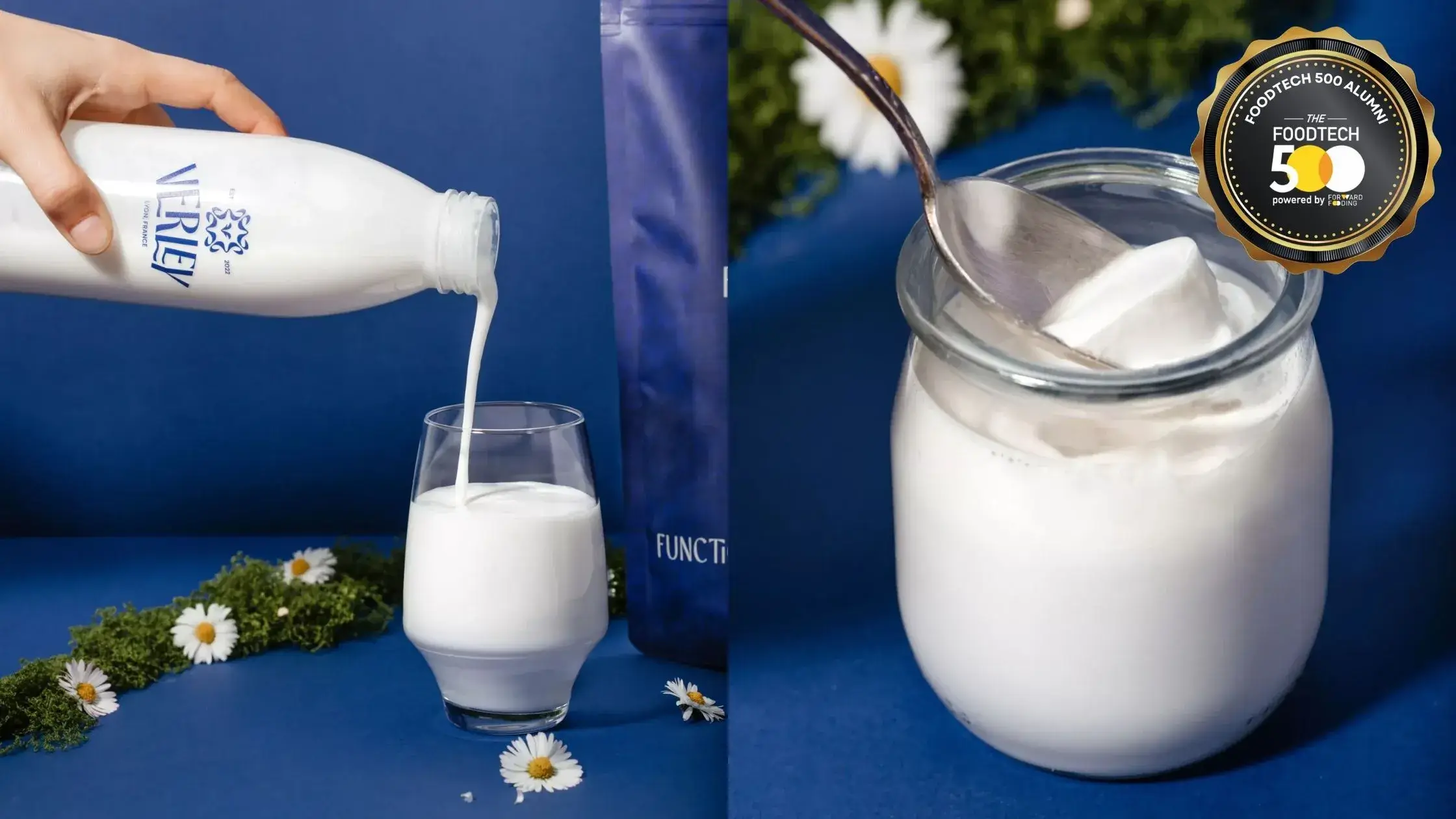
And when asked about the possibility of creating B2C products:
Forward Fooding: How do you balance the strategic decision to focus on B2B and whey proteins with potential future opportunities in B2C or casein-based products, should market conditions shift significantly?
Stéphane Mac Millan and Hélène Briand: Our B2B model enables us to scale impact quickly by partnering with established food and nutrition companies. We’ve focused on whey proteins because of their market traction, functional advantages, and cost-effectiveness. Caseins remain structurally complex and less aligned with current demand.
That said, we remain opportunity-driven and agile. In the future, this could mean expanding into casein, other dairy proteins, or even non-dairy proteins, depending on how market needs and technologies evolve. Our approach is to build a strong foundation with high-performing, scalable ingredients and remain ready to adapt as new opportunities emerge.
Our strategic focus on B2B and whey over casein helps us avoid common pitfalls and position ourselves for sustainable growth rather than quick hype.
Forging a Sustainable Future for Protein
Conventional dairy production comes with a heavy environmental footprint. Which is why Verley’s use of precision fermentation technology is a viable solution, not just to bridge the protein gap, but also to ensure sustainability in production.
Forward Fooding: How do you ensure your Life Cycle Assessment (LCA) metrics remain competitive and accurately reflect your environmental impact as production scales and processes evolve?
Stéphane Mac Millan and Hélène Briand: Our current LCA — peer-reviewed and ISO-compliant — shows substantial environmental gains vs. conventional dairy: -72% GHG emissions, -99% arable land use, and -60% fossil energy, as was measured at industrial scale.
Besides, as we keep scaling up, we are building systems to track energy, water, and raw material inputs in real-time, enabling us to update our LCA with actual production data. Environmental impact is a key part of our product performance framework, and we are committed to maintaining transparency and continuous improvement.
Beyond environmental metrics, Verley also rigorously tracks nutritional efficiency, such as leucine content per gram of protein, and scalability, measuring production volume per fermentation cycle. This dual focus ensures that their proteins are not only sustainable but also nutritionally superior and viable for large-scale industrial adoption.
Forward Fooding: It’s 2035, and Verley has achieved its vision. What’s the headline you’d be most proud to read about the company?
Stéphane Mac Millan and Hélène Briand: “Thanks to Verley’s work and breakthrough technology, we are about to fix the protein gap while reducing the pressure our food system is putting on our earth.”
The Road Ahead: Scaling Impact and Redefining Dairy
Our FoodTech Data Navigator tracks the rapidly evolving precision fermentation ecosystem. The sector has seen significant investment growth in recent years as the technology matures and regulatory pathways become clearer. Companies are working on everything from dairy proteins to fats, egg proteins, and functional ingredients.
Within this landscape, Verley’s approach stands out for its focus on a specific protein type (whey), commitment to B2B partnerships, and rapid progression through regulatory milestones. The company’s ability to offer a full range of protein ingredients, rather than a single product, also provides flexibility as customer needs evolve.
Verley is on a steep upward trajectory, with current production already reaching 50 tons. The company is poised to announce a new fundraising round to fuel its expansion and cement its path to commercialisation in the US by 2026. This aggressive scale-up is underpinned by a clear vision for the future, where their precision-fermented proteins become a global standard.
Curious about the future of dairy ingredients? Discover how Verley’s FermWhey™ range can elevate performance and sustainability. Visit www.verley-food.com
Forward Fooding is the world’s first collaborative platform for the Food & Beverage industry via FoodTech Data Intelligence and Corporate-Startup Collaboration – Learn more about our Consultancy and Scouting Services and our Startup Network.