Ashwagandha has gone from a niche Ayurvedic herb in India to one of the most mainstream ingredients in FoodTech. You now find it in drinks, gummies, snack bars, and even alcohol alternatives. Yet, behind the hype lies a complex reality: strong market traction, but uneven scientific consensus, volatile supply chain and increasing regulatory constraints in Europe.
What is Ashwagandha?
Ashwagandha (Withania somnifera) is a medicinal plant traditionally used in Ayurveda, particularly in India, where it has been consumed for over 3,000 years. Traditionally, it has been valued for helping the body manage stress, improve energy and vitality, support sleep, and promote reproductive health.
Today, it is commonly described as an adaptogen (helping the body respond to stress) and increasingly as a nootropic (may enhance brain function), due to its potential effects on mood and cognition, similar to ginseng or rhodiola.
Health benefits: what’s solid vs what’s unclear
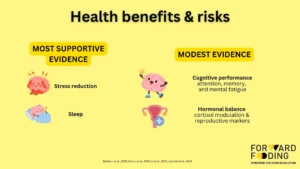
Research on ashwagandha has grown rapidly in recent years, but not all claimed health benefits are supported to the same extent. Some effects are consistently observed across studies, while others remain more exploratory.
What is relatively well supported
- Stress reduction: Several randomized controlled trials and systematic reviews show reductions in cortisol levels and perceived stress.
- Sleep: Clinical studies and meta-analyses show small but consistent improvements in sleep quality.
What looks promising but needs more validation
- Cognitive performance: Recent clinical studies suggest that ashwagandha can improve attention, memory, and mental fatigue, both acutely and over time, but effects are modest and still need validation in larger, more diverse populations.
- Hormonal balance (especially in women’s health): Some studies suggest effects on the endocrine system (e.g., cortisol, reproductive hormones), but mechanisms and consistency are still unclear.
Health risks and safety signals to consider
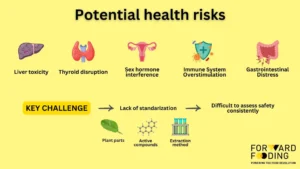
According to recent reviews of preclinical and clinical evidence, several safety considerations have emerged:
- Hepatotoxicity (liver toxicity) → most credible signal, based on rare but documented case reports, often linked to high doses or poor-quality products.
- Thyroid disruption → disputed; evidence shows both potential benefits and risks depending on the population.
- Sex hormone interference → under investigation; effects (e.g., testosterone increase) can be framed as benefit or risk.
- Gastrointestinal distress → relatively common; includes nausea, stomach upset, vomiting, and diarrhea, especially at higher doses.
- Immune system overstimulation → potential risk; may exacerbate autoimmune conditions such as lupus, rheumatoid arthritis, or Hashimoto’s thyroiditis.
Moreover, certain groups are generally advised to avoid or use caution: pregnant women, individuals with thyroid disorders or liver disease, and those taking specific medications.
A key challenge is the lack of standardization. Differences in plant parts, active compound levels, and extraction methods make it difficult to assess safety consistently across products.
This format variability and possible health risks are central to the current regulatory complexity (explored in the next sections).
Market growth and what’s driving it
The global ashwagandha market is already approaching $815M in 2025 and is expected to more than double to ~$1.79B by 2035 (8.2% CAGR), according to Future Market Insights 2025. The supplements segment remains the largest, growing at ~9–13% CAGR, but the fastest momentum is now shifting toward food and beverage formats. Based on Forward Fooding analysis of multiple industry reports, functional foods and beverages using ashwagandha are growing at an estimated ~15.6% CAGR, making them the fastest-expanding segment.
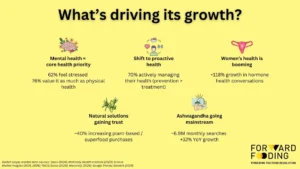
What’s driving this growth?
Mental health is now a health priority – 62% of people globally report feeling stressed and 76% of people say mental health is as important as physical health (Ipsos, 2024; McKinsey Health Institute, 2023).
Prevention, longevity and healthy aging are becoming the default model – Consumers are moving from reactive to proactive health, seeking everyday solutions rather than treatments, with 70% of consumers proactively managing their health (Innova Market Insights, 2026; FMCG Gurus, 2025).
Women’s health is emerging as a key growth area – Food and beverage conversations around hormone health rose +118% (2022 to 2024). Women’s health is now one of the fastest-growing spaces in functional food, with positioning around premenstrual syndrome, cortisol, and hormonal balance gaining traction (Innova Market Insights, 2025).
Natural, plant-based solutions are gaining trust – Around 40% of global consumers plan to increase purchases of plant-based or “superfood” products. Botanicals like ashwagandha benefit from both traditional credibility and alignment with clean-label trends (NielsenIQ, 2024).
Rising consumer awareness – Ashwagandha now sees ~6.9M monthly Google searches globally, with +32% year-over-year growth, reflecting a shift into mainstream awareness (Google Trends; Glanbia, 2025).
How FoodTech Companies are using it
This shift is already visible within the broader FoodTech landscape. According to Forward Fooding’s FoodTech Data Navigator, Brain & Cognitive Health included 327 companies globally between 2020 and 2025, making it one of the most active and fastest-growing functional health clusters. Within this space, ashwagandha remains a relatively small but emerging niche: we estimate between 15 and 20 companies use it as a core ingredient or positioning lever.
From supplement to everyday format – Format innovation is driving adoption
Ashwagandha is no longer confined to supplements or capsules. It is increasingly embedded into formats that fit everyday routines, from ready-to-drink (RTD) beverages and functional teas to coffee alternatives, gummies, snacks, and alcohol-free social drinks.
In the FoodTech space, innovation is concentrating around a few key format and use-case categories:
- RTD beverages and social tonics are the dominant format for adaptogens in food and beverage. According to industry reports, ~43% of adaptogen-containing products are delivered in RTD formats, with ashwagandha among the most frequently used ingredients in this category (35% share).
- Gummies and chews are emerging as a fast-growing delivery format, particularly in the U.S., driven by convenience and compliance. The segment reached ~$1.9B in 2025 and is growing at ~12–13% CAGR, reflecting broader growth in functional confectionery.
- Women’s health formats are emerging as a high-potential niche, with targeted products positioned around PMS, cycle support, and hormonal balance (e.g., brands like The Cycle reflect this move, using ashwagandha in RTD beverages designed specifically for period relief).
Leading signals from the startup ecosystem
- TRIP → Functional RTD drinks positioned around calm and stress relief. Reached $100M in revenue (2025), profitable, and now distributed globally, a clear proof that adaptogen beverages can scale in mainstream retail.
- Grüns → Daily greens + adaptogen gummies designed to replace traditional supplements. Hit $300M ARR in under 2 years and was acquired by Unilever for $1.2B (2026), one of the strongest signals that functional gummies with adaptogens have reached scale.
- IMPOSSIBREW → Alcohol-free beer infused with nootropics and adaptogens for “social relaxation.” Sold 1M+ cans in the last 12 months and raised ~£1.5–1.6M (2025), showing traction in the sober-curious and functional alcohol space.
- Mosh → Brain-health snack bars combining protein with functional ingredients. Built a 150,000+ customer base, proving adaptogens can work in everyday snacking formats.
- Clevr Blends → Adaptogen-based latte powders positioned as a coffee alternative. Expanded into 500 Target stores (2024), marking a key step from D2C to mass retail.
- Spacegoods → Adaptogen + nootropic powder blends targeting focus and productivity. Raised €2.9M seed, highlighting investor confidence in the “calm energy” and coffee-replacement category.
Behind these consumer brands sits a less visible but critical layer of B2B infrastructure. Ingredient companies such as KSM-66 / Ixoreal Biomed, now used by more than 4,500 brands globally, are enabling the category by solving key technical constraints. These include managing bitterness and astringency, improving solubility and dispersion in liquid formats, ensuring stability across processing conditions, and standardizing bioactive compounds for consistent efficacy.
Investment, M&A, and corporate signals
- Strategic capital is entering early: Constellation Brands leading a $19M round in Hiyo (social tonics) (2025) shows big players are betting on functional, alcohol-adjacent drinks.
- M&A is happening, but at the brand level: Big deals like Grüns signal value in consumer formats, while ingredient suppliers (KSM-66, Arjuna, Sabinsa) remain independent.
- Still a fragmented space: No clear category leader yet → consolidation likely ahead.
- Who will likely win: Brands with clinical backing, proprietary formulations, or strong supply chains are the most likely acquisition targets.
Regulatory landscape
The debate is no longer “is ashwagandha safe?”, but “under what conditions is it safe?”.
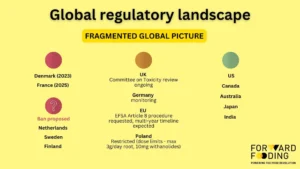
A fragmented global picture: Country-level restrictions
Regulation of ashwagandha varies significantly across regions, creating a highly fragmented global landscape. Europe is increasingly moving toward a precautionary approach, while markets like the US and parts of Asia remain more permissive. In contrast, in India, ashwagandha is a recognized traditional botanical with defined standards for plant part, dosage, and quality.
| Country | Status | Authority | Key Action / Notes |
|---|---|---|---|
| Denmark | BANNED | Danish Vet & Food Admin (DVFA) | Full ban since April 2023. First EU country. DTU 2020 risk assessment cited. RASFF alerts issued for online products. |
| France | BANNED (from 2025) | ANSES | Included on banned plants in supplements list. ANSES 2024 precautionary warning for vulnerable groups preceded full ban. |
| Netherlands | BAN PROPOSED | NVWA | Proposed ban via Commodities Act amendment (2025). Consultation closed Mar 2025. Liver damage + abortifacient concerns cited. |
| Sweden | UNDER REVIEW | Swedish Food Agency | Applying Danish DTU assessment by reference. Municipal enforcement varies. Certain high-dose products removed. |
| Finland | UNDER REVIEW | Finnish Food Authority | Actively considering action; referencing Denmark assessment. No formal ban yet. |
| Poland | RESTRICTED | Chief Sanitary Inspectorate (GIS) | Max 3g/day root powder; max 10mg withanolides/day. Products complying with limits allowed. |
| Germany | MONITORING | BfR | BfR 2013 report recommended Article 8 procedure. Products marketed under food supplement rules; local authority enforcement varies. |
| EU (EFSA) | ASSESSMENT PENDING | EFSA / EC Heads of Food Safety | HoA recommended Article 8 procedure (Reg. EC 1925/2006) in 2024. EFSA risk assessment timeline unknown — could affect all 27 member states. |
| United Kingdom | UNDER REVIEW | UK FSA / CoT | Call for Evidence: July–Sep 2024 (19 responses). Presented to CoT Mar 2025. Final recommendation pending. Currently PERMITTED. |
| United States | PERMITTED | FDA (DSHEA 1994) | Sold freely as dietary supplement. No specific FDA safety warnings. GRAS status for traditional amounts. |
| Canada | PERMITTED (NHP) | Health Canada (NHPD) | Licensed as Natural Health Product. KSM-66 and Shoden both have NPN approvals with health claims. Excluded from supplemented foods list. |
| Australia | PERMITTED | TGA | Any plant part / extract type permitted in complementary medicines. TGA safety advisory Feb 2024 noted adverse events (mainly digestive). |
| India | FULLY PERMITTED | FSSAI / AYUSH | Country of origin; deeply embedded in Ayurvedic tradition. Approved ingredient under FSSAI food supplements regulations. Major extract production base. |
| Japan | REGULATED (FOSHU) | MHLW | Permitted in health foods. Must comply with FOSHU or FHC frameworks. Growing uptake in functional beverage market. |
Sources: DVFA, ANSES, NVWA, EFSA, UK FSA, BfR, GIS, WHO/NIH, FSSAI, TGA, Health Canada, MHLW.
Where regulation is heading
There is growing alignment, even among industry, that the solution is not a full ban, but better standardization:
- Use root-only extracts (avoid leaf-related risks).
- Ensure standardised withanolide levels (the concentration of the plant’s main active compounds responsible for its biological effects).
- Define maximum daily dose limits.
Beyond regulation: supply chains and global context
While much of the current debate focuses on regulation in Europe and North America, ashwagandha’s origins and supply chains tell a broader story that is often overlooked.
Ashwagandha is primarily cultivated in India, where it has deep cultural and economic significance. As global demand accelerates, this raises important questions around sourcing, equity, and sustainability.
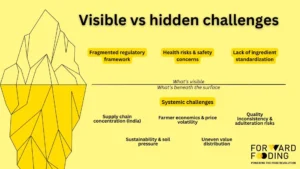
- Supply concentration → India dominates global supply, with cultivation concentrated in regions like Madhya Pradesh and राजस्थान. This creates geographic dependency and exposes global markets to climate variability, crop yield fluctuations, and export dynamics.
- Farmer economics → Rising international demand has increased incomes for some farmers, but also introduced volatility. Prices can swing significantly depending on export demand and quality grades, and smallholders often have limited bargaining power within fragmented supply chains.
- Quality vs scale trade-offs → As demand outpaces high-quality supply, reports of adulteration (substitution with other نباتicals or low-grade material) and inconsistent extract quality have increased. Lack of transparent traceability systems makes it difficult for downstream brands to guarantee consistency.
- Sustainability pressures → intensified cultivation, often without regenerative practices, can lead to soil degradation and reduced biodiversity. At the same time, climate sensitivity (rainfall variability, temperature stress) is emerging as a risk for long-term supply stability.
- Value capture imbalance → Most of the economic value is created downstream (brands, formulations, retail), while upstream producers capture a smaller share, raising broader questions around equity in global botanical supply chains.
This highlights a broader tension: while regulation in the Global North focuses on safety and standardization, much of the value chain, and its risks, sits in the Global South.
Future Outlook → What this means for FoodTech
Ashwagandha is rapidly moving from supplements into the core of functional food and beverage, where success depends on combining clear use cases (e.g., stress, sleep, hormonal health), everyday formats, and credible science.
While the category is scaling fast, it remains fragmented, with consolidation likely around brands that pair traction with strong technical and regulatory defensibility. At the same time, increasing scrutiny, particularly in Europe, will make standardization and quality a key competitive advantage. Beyond regulation, its supply chains introduce another layer of complexity: with production concentrated in India, the category faces challenges around sourcing volatility, quality consistency, sustainability, and uneven value distribution across the value chain.
Ultimately, ashwagandha is not just a high-growth ingredient, it is a test case for FoodTech itself: whether the industry can scale natural, culturally rooted ingredients responsibly, sustainably, balancing innovation with scientific rigor, regulatory alignment, and fair, resilient supply systems.
Forward Fooding is the world’s first collaborative platform for the Food & Beverage industry via FoodTech Data Intelligence and Corporate-Startup Collaboration – Learn more about our Consultancy and Scouting Services and our Startup Network.