
Welcome to the Forward Fooding Novel Ingredients Series, a new editorial strand where we go deep on the ingredients we think will define the next decade of food. Not hype, not speculation. Just the science, the companies, the data, and the timing. Edition 4: Lactoferrin.
Why human-identical milk components are the next frontier
Food tech companies have spent years trying to replace whole foods such as milk and meat, often competing with products that are cheap, familiar, and produced at enormous scale. Human-identical milk components offer a different business case. Instead of recreating milk itself, companies are using biotechnology to produce specific molecules found in human milk, particularly human milk oligosaccharides (HMOs) and lactoferrin. These ingredients are present in small amounts but are linked to gut development, immune function, microbiome formation and early-life nutrition.
Their value also changes the economics of production. Dairy proteins such as whey are sold in large volumes at relatively low prices, while purified lactoferrin can sell for more than $650 per kilogram because it is costly to isolate from cows’ milk and available only in limited quantities. HMOs are similarly used as premium, low-dose ingredients. This makes both molecules better suited to production methods that remain expensive at scale. Infant nutrition remains the main market, but companies are also testing their use in adult gut health, immune support, healthy ageing and medical nutrition.
What are Lactoferrin & HMOs
To understand why biotech is obsessed with breast milk, we first have to understand the unique superpowers of its two most valuable components: Lactoferrin and HMOs.
Lactoferrin: a protective milk protein
Lactoferrin is an iron-binding protein found in human milk, especially in colostrum. It can exist in different forms depending on how much iron it carries:
- Iron-Depleted (Apo-lactoferrin): In this state, the protein acts like an iron magnet. By soaking up free iron in the gut, it starves harmful pathogens (like bad bacteria and viruses) that require iron to multiply.
- Iron-Saturated (Holo-lactoferrin): In this state, the protein is fully loaded with iron, making it an incredibly efficient delivery vehicle to help the body absorb and utilize this vital mineral.
HMOs: sugars that feed microbes in our gut
HMOs are a large family of complex sugars found naturally in breast milk. More than 200 structures have been identified, although the type and concentration vary between people and animals and over the course of lactation. Unlike lactose, HMOs are not primarily a source of energy for the infant. Most pass through the digestive system without being broken down and instead act as food for selected gut bacteria, particularly certain Bifidobacterium species.
HMOs can also help prevent pathogens from attaching to the gut lining. Some bacteria and viruses bind to HMOs instead of intestinal cells, which may reduce their ability to cause infection.
How they are made: why precision fermentation
Historically, sourcing these ingredients has been an economic and logistical nightmare:
- Commercial lactoferrin is usually extracted from cows’ milk or whey, where it is present in very small amounts. Large volumes of dairy therefore have to be processed to recover a relatively small quantity of the protein. The result is a limited and expensive supply of bovine lactoferrin rather than the human form found in breast milk.
- HMOs cannot be extracted from cows’ milk at all. Before biotechnology made larger-scale production possible, they could only be obtained from donated human milk or made in small quantities through complex chemical and enzymatic processes. Even now, manufacturers can reproduce only a small selection of the roughly 200 HMO structures identified in human milk.
Precision fermentation: scaling the unscalable
Precision fermentation provides a promising route. Scientists give a microorganism, usually yeast or bacteria, the biological instructions needed to make a specific lactoferrin protein or HMO. The microorganism is grown in fermentation tanks, where it converts sugars and other nutrients into the target ingredient. The ingredient is then separated, purified and dried for use in food or supplements. This approach can produce a consistent molecule without relying on scarce human milk or processing large quantities of dairy. It can also provide a more predictable supply and allow manufacturers to produce human-identical lactoferrin or selected HMOs at a scale that was previously difficult to reach.
For instance, according to biotech pioneer TurtleTree, extracting 1 gram of lactoferrin traditionally requires 10 liters of cow’s milk. In contrast, 10 liters of TurtleTree’s engineered yeast can express over 100 grams of human-identical lactoferrin. By eliminating the reliance on animal agriculture, precision fermentation offers a predictable, highly pure, and scalable supply of these high-value bioactives.
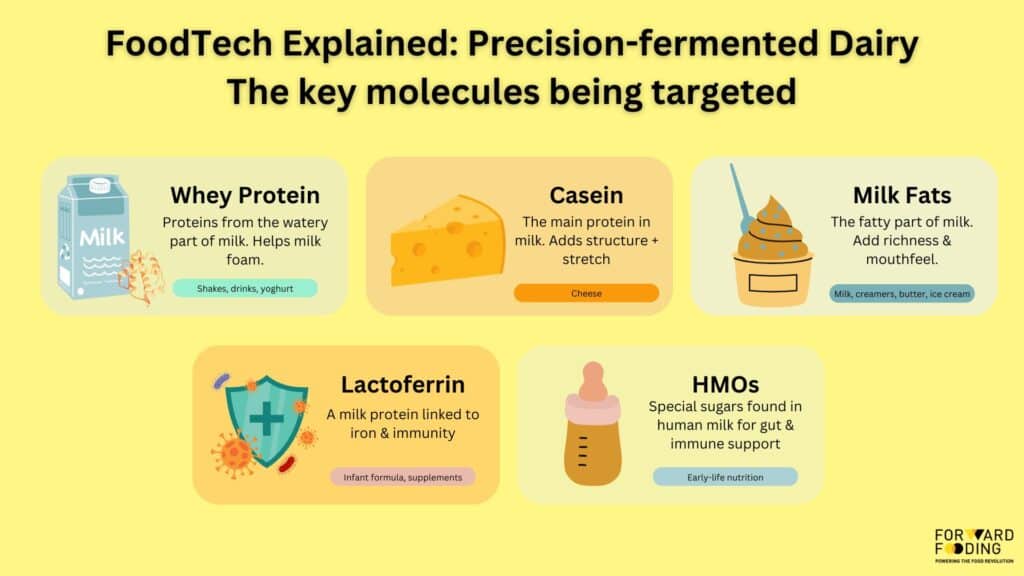
Readers can find a more detailed explanation of the process in our Foodtech Explained article on precision-fermented dairy.
Applications beyond infant formula
While infant nutrition remains the primary market, the incredibly high margins of these ingredients are unlocking massive new business cases in adult health:
- Healthy Aging and women’s health: Lactoferrin is moving into adult health and performance products. Helaina is positioning its human-identical effera® ingredient for women’s health, active nutrition, healthy ageing and gut support, with brands including Kroma Wellness, Levelle Nutrition and Healthgevity developing products around it. TurtleTree has also partnered with Strive on an adult immune-support drink and protein powder containing LF+, while exploring use in ready-to-drink coffee with Mad Foods.
- Next-gen prebiotics: HMOs are entering the adult microbiome market as next-generation prebiotics. Layer Origin already sells PureHMO®, based on 2’-FL, and SuperHMO®, a blend of five HMOs, as powders and capsules for adult gut health.
Who is building this: The Commercial Landscape
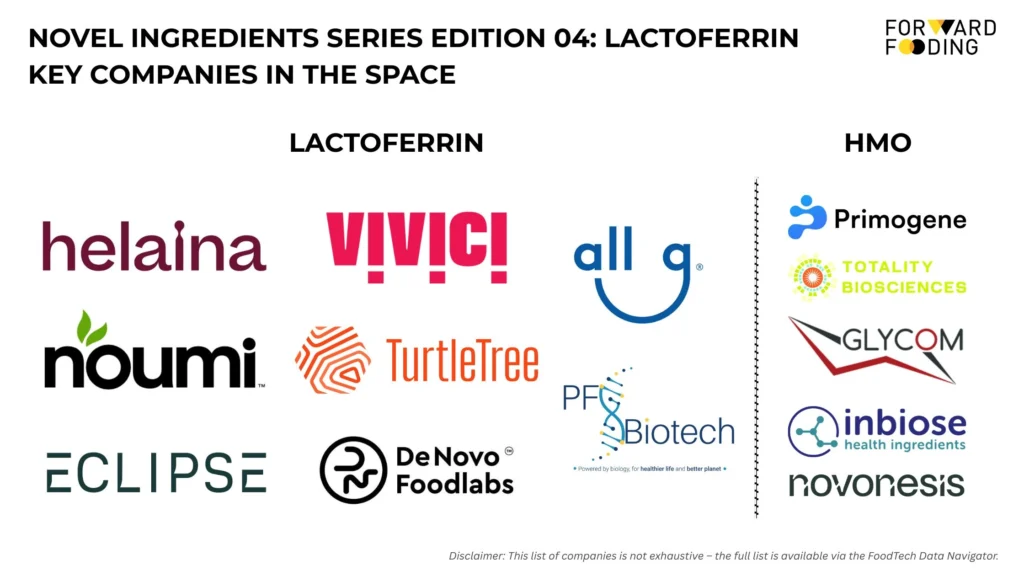
We’ve been tracking the Lactoferrin category closely on the FoodTech Data Navigator, and the ecosystem that’s assembled in the last three years is striking. Here’s where things stand with the leading players:
Totality Biosciences (United States | Early-stage)
Totality Biosciences is taking a different route. Instead of using microorganisms, the company is engineering food crops to produce HMOs directly in plants. The aim is to make a wider range of simple and complex HMOs at lower cost than current fermentation methods. Its work shows that future HMO production may draw on several systems, including microbes, plants and enzymes, depending on the complexity and volume of the molecule required.
TurtleTree (Singapore and United States | $42.3M raised | Strategic round)
TurtleTree produces LF+, a bovine lactoferrin made through precision fermentation without relying on cows’ milk. Unlike Helaina, which focuses on the human form, TurtleTree is recreating a protein already used commercially in infant formula, supplements and functional foods, but with a more controlled production route.
The company has also worked to secure regulatory acceptance and manufacturing partnerships intended to move LF+ from pilot production towards wider commercial supply.
In July 2026, TurtleTree partnered with Novonesis to support commercial-scale production and global market expansion.
Inbiose (Belgium | €36M raised | Series B)
Belgian biotechnology company Inbiose specialises in HMOs produced through precision fermentation. Its portfolio includes 2’-FL, LNnT and combinations of several HMOs for infant, adult and pet nutrition, with products cleared for use in markets including the United States and Europe.
Backing from investors including Danone’s venture arm reflects continued interest from major infant-nutrition companies in moving beyond single-HMO products towards broader ingredient portfolios.
Helaina (United States | $73.3M | Series B)
New York-based Helaina uses precision fermentation to produce effera®, a lactoferrin designed to be functionally equivalent to the human protein. The ingredient is already being used in products targeting women’s health, gut health, active nutrition and healthy ageing, while infant nutrition remains a major long-term market.
Helaina raised a $45M Series B in 2024 and partnered with Nestlé in 2026 to explore bioactive proteins for infant nutrition. The collaboration combines Helaina’s protein-production platform with Nestlé’s infant-nutrition and product-development expertise.
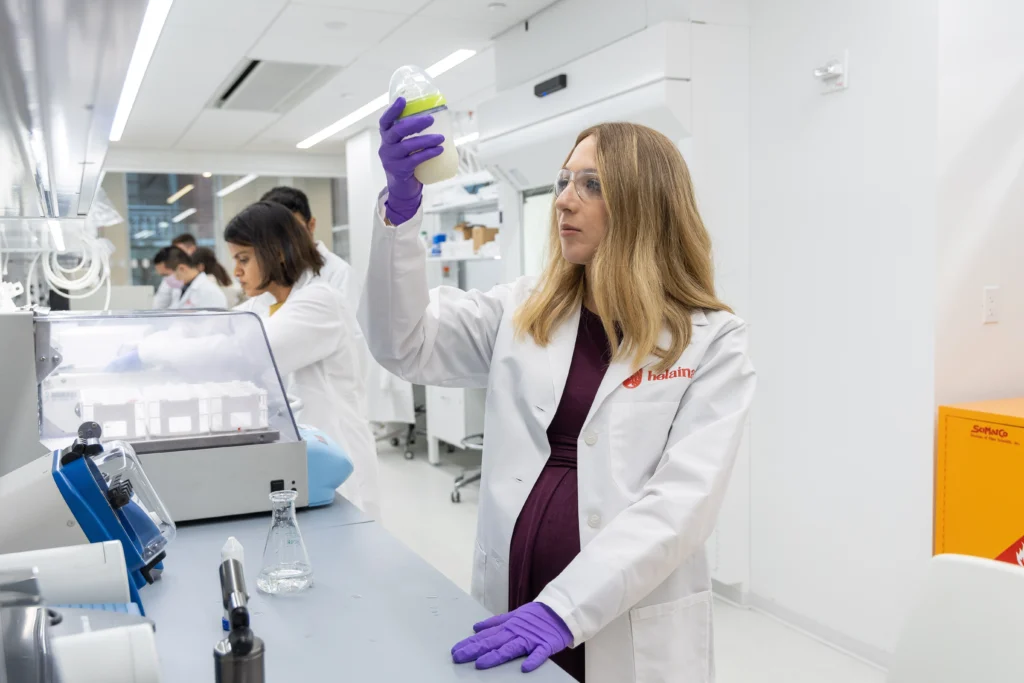
Courtesy: Helaina
Why now: regulation, better technology and corporate interest
The sudden acceleration of the lactoferrin and HMO markets isn’t an accident. It is the result of five major forces: regulation, industrial scale, and scientific maturity, finally aligning.
- A proven commercial pathway: Large nutrition companies have already adopted the first generation of human-milk components. Nestlé, Danone, or Abbott have incorporated HMOs into parts of their infant-nutrition portfolios, providing a commercial precedent for adding more complex bioactives.
- Regulation is beginning to open the market: In May 2025, TurtleTree’s LF+ became the first precision-fermented lactoferrin to receive an FDA “no questions” letter. The clearance covers selected food, beverage and supplement applications, although not yet infant formula.
- Ingredient manufacturers are preparing for scale: In July 2026, Novonesis agreed to scale, manufacture and commercialise TurtleTree’s LF+ for early-life nutrition, while also taking a minority stake in the company. The deal gives TurtleTree access to the production and commercial infrastructure of a global biosolutions supplier.
- The technology can now make more complex ingredients consistently: Fermentation platforms are improving their ability to reproduce specific proteins and sugars, control purity and maintain functionality across batches. For lactoferrin, scientists can now control the exact level of iron saturation across production batches. This allows manufacturers to tailor the ingredient’s behavior for highly specific food, beverage, or supplement applications.
- Infant nutrition is becoming more function-specific: Formula development has gradually moved from matching basic nutrients towards adding selected fats, HMOs and other bioactives associated with particular functions.
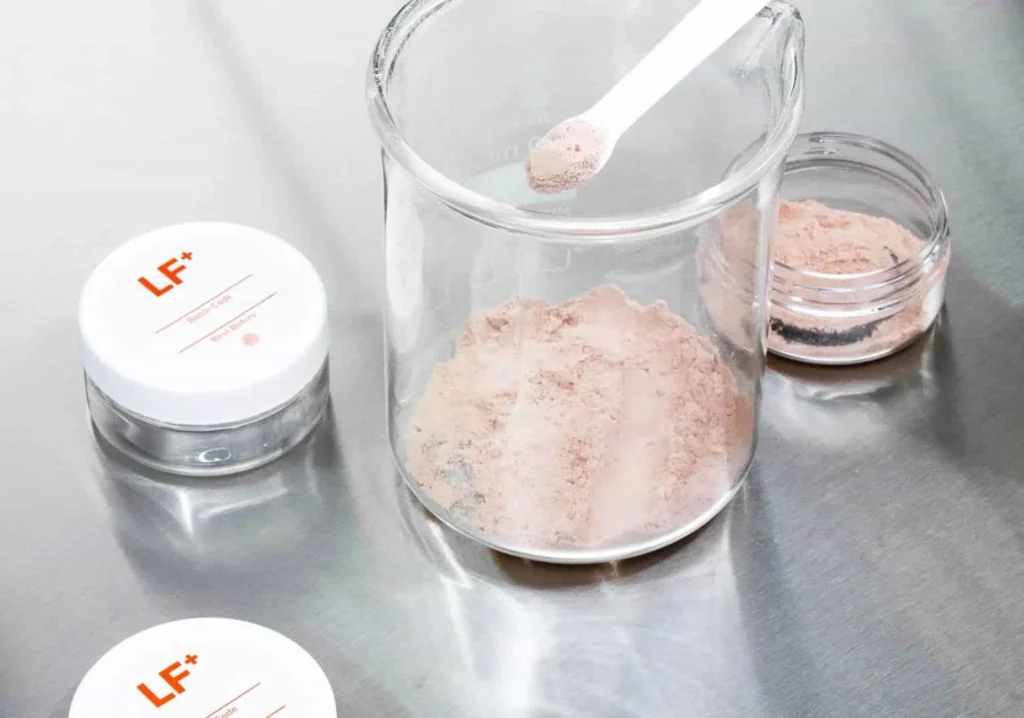
Courtesy: Turtletree
What remains difficult
Despite the breakthrough science, transitioning these delicate human-identical bioactives from a fermentation tank into a commercial product comes with complex hurdles:
- Matching the molecule is not enough. Having the right amino acid sequence is only half the battle. If the protein does not “fold” correctly or fails to bind iron properly under real-world conditions, it loses its biological function.
- Cost and scale remain limiting. While producing high-purity lactoferrin or HMOs is technically viable in a laboratory, doing so cheaply enough to compete on the mass market is incredibly difficult. Startups must optimize yield and purification processes to bring costs down to a level that formula manufacturers can absorb.
- Infant nutrition faces a higher regulatory bar. Regulators need evidence not only that the ingredient is safe, but that it remains safe and appropriate when used in a complete formula and consumed by infants.
- Manufacturing can reduce functionality. Infant formula and functional beverage manufacturing is brutal. High-heat pasteurization, intense spray-drying, and months of shelf storage are required for food safety. However, these harsh industrial processes can easily alter or “denature” delicate, living proteins.
- The “One-Size-Fits-All” paradox. Unlike standardized chemistry, human biology is highly variable. Every individual’s gut microbiome is different, and infants respond differently to various HMOs based on genetics. Designing a mass-market formula with highly targeted bioactives that must work safely and effectively for a broad population remains an ongoing puzzle.
Forward Fooding is the world’s first collaborative platform for the Food & Beverage industry via FoodTech Data Intelligence and Corporate-Startup Collaboration – Learn more about our Consultancy and Scouting Services and our Startup Network.