
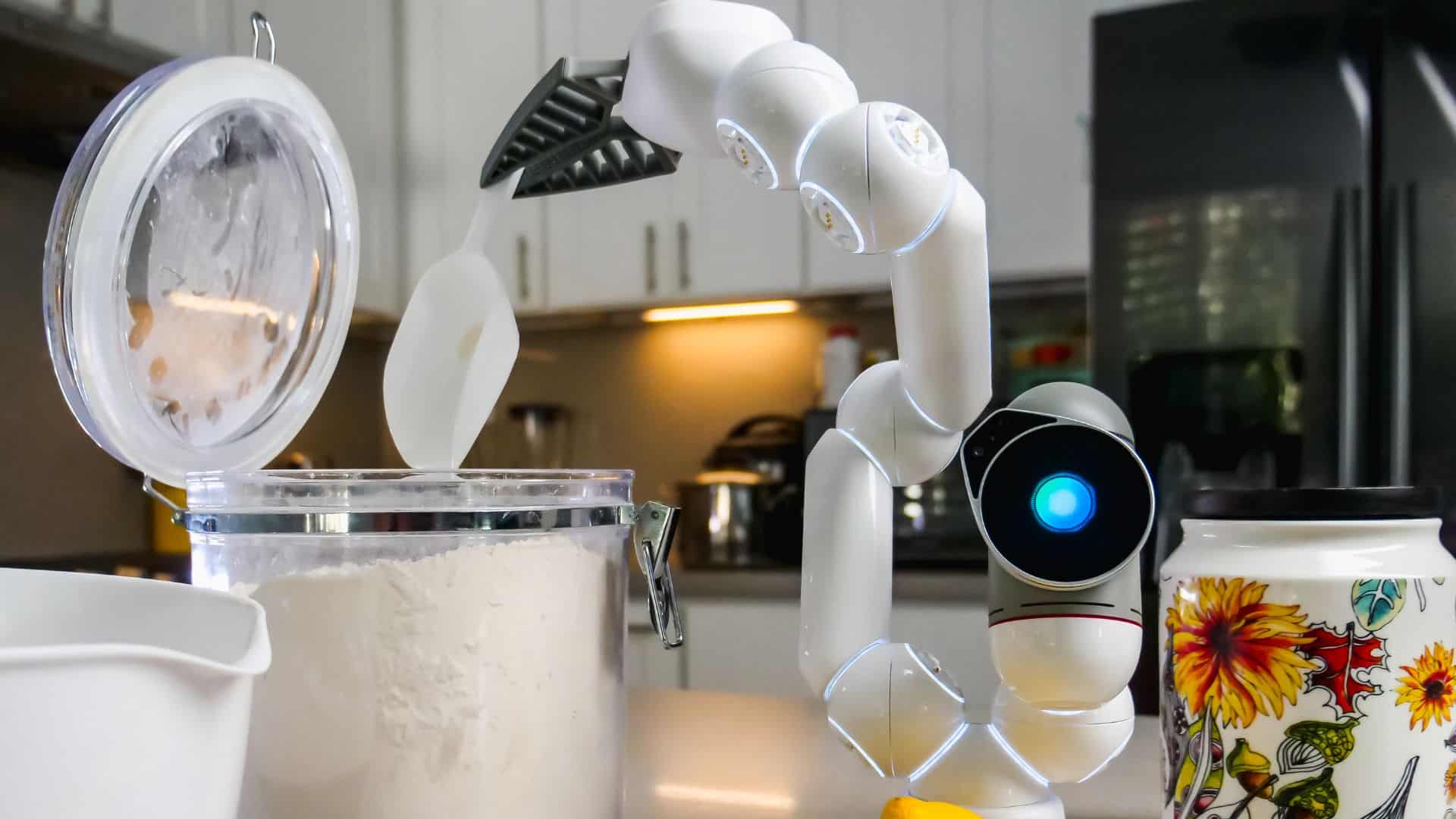
$10.7B raised and 40 to 50% of companies dead (Forward Fooding’s FoodTech Data Navigator). White Castle signed up for 100 Flippy fry stations and got 13 into operation. The industry blames the technology, the capital costs, the integration complexity. Those things are real. They are not the point. In most cases where food robotics has failed, the machine was fine. The food wasn’t ready for it. Neither was the culture.
What is kitchen automation?
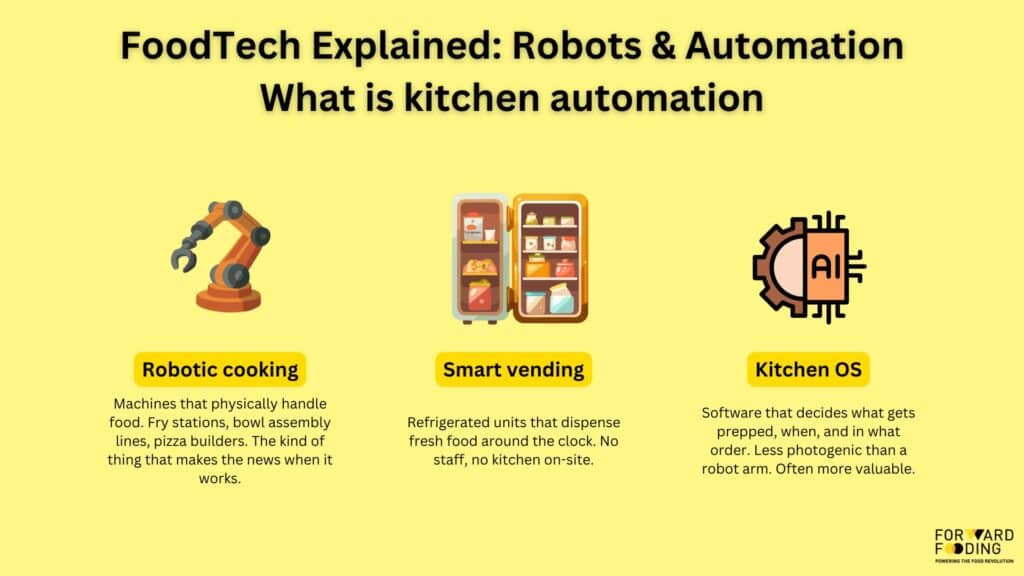
Food automation is not just a robot arm flipping burgers. In foodservice, automation usually refers to three different layers:
- The first is the robot you picture: a machine that physically handles food. Fry stations, bowl assembly lines, pizza builders.
- The second is the smart vending machines. Refrigerated units that dispense fresh food around the clock with no staff and no kitchen on-site.
- The third is software. The invisible layer that decides what gets prepped, when, and in what order. Ordering logic, inventory, throughput. This includes ordering systems, inventory forecasting, kitchen display systems, prep planning, labour scheduling, and throughput optimisation. Less photogenic than a robot arm but often more valuable.
Why is it rising?
Labor is the number one operational challenge for foodservice operators worldwide. Kitchens run on thin margins, with high turnover, hard-to-fill shifts, and rising wage costs. In 2025, 77% of restaurant operators still said recruiting and retaining employees was a significant challenge, according to the National Restaurant Association’s 2025 State of the Restaurant Industry report.
The pandemic accelerated a labour crisis that was already building. Restaurants that had relied on a steady supply of back-of-house workers suddenly struggled to staff fryers, grills, prep stations, and assembly lines. Investment followed: kitchen automation funding surged 121% between 2020 and 2022, peaking at $927M, according to Forward Fooding’s FoodTech Data Navigator. After the market corrected, capital did not disappear; it became more selective, concentrating on models that had proved they could work in real kitchens.
That is why automation is taking hold first in high-friction tasks: the fry station nobody wants to staff, the assembly line where consistency matters, the kiosk that can serve food overnight in a hospital corridor, or the software that helps teams prep the right amount at the right time. It is a targeted fix for the places where human labor is hardest to find, retain, and afford.
Where is it working?
Food automation is working best in high-traffic, constrained environments where the food is standardised and the task is narrow, repetitive, and done at volume.
Sweetgreen’s Infinite Kitchen is a good example. The Infinite Kitchen is a conveyor-based assembly system that portions, builds, and dispatches salad bowls to order. By end of 2025, it had rolled out to 30+ locations, and the majority of all new Sweetgreen openings now use robotic assembly as the default. Locations with the Infinite Kitchen report 10% higher average ticket values than traditional stores. The reason it works: every ingredient is standardised before it enters the system: uniform cuts, consistent weights, controlled moisture. The robot doesn’t deal with food as it comes, it deals with food as it’s been designed to behave. In November 2025, however, Sweetgreen agreed to sell the Infinite Kitchen business to Wonder for $186M, a reminder that even the best-executed deployment proved easier to spin off than to scale in-house.
Another example would be Farmer’s Fridge. Farmer’s Fridge removed the kitchen from the equation entirely. Its refrigerated kiosks dispense fresh salads, bowls, and meals 24/7 in hospitals, airports, and corporate offices, locations where there is no staff, no kitchen on-site, and demand runs around the clock. Over 2,000 fridges are now deployed across the US. Revenue tripled over three years and the company is installing 10-15 new units per week. What makes it work is not the hardware. It’s the supply chain behind it: centralised production, precise portioning, fixed packaging, short shelf-life management, and reliable replenishment.
Why food is a nightmare for machines
Every other industry that has automated successfully works with predictable materials. Steel arrives at the same hardness. Screws arrive at the same size. The machine knows exactly what it’s getting, every time.
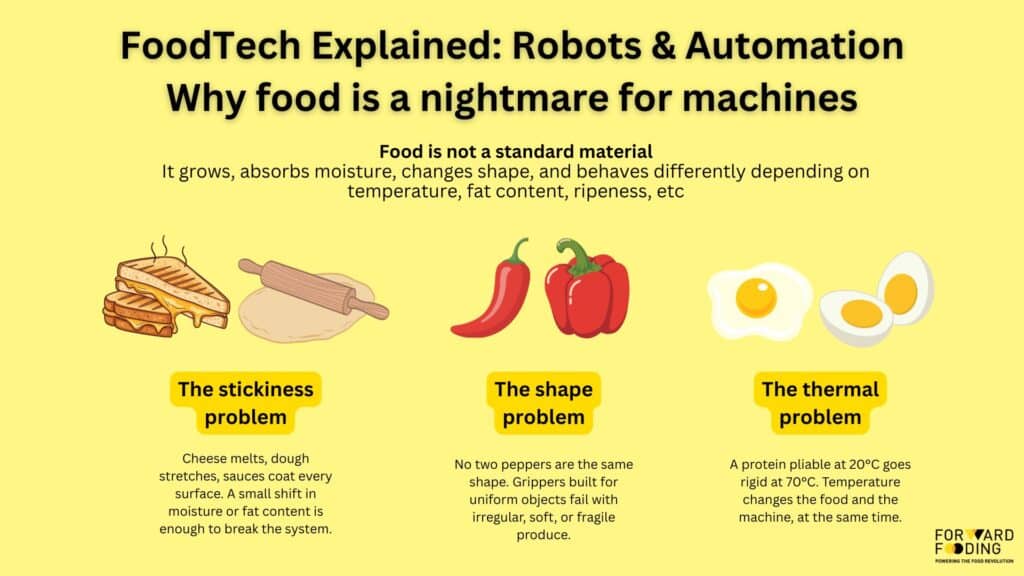
Food doesn’t work like that. It’s a biological material. It grew somewhere, was affected by weather, ripened at a slightly different rate, absorbed moisture on the way to the kitchen. Two tomatoes from the same farm on the same day are not the same tomato. That variability is invisible to the human hand, which adjusts instinctively. To a robot, it’s a system failure waiting to happen.
Three common problems:
- Stickiness: Food sticks to surfaces, to itself, to grippers. Cheese melts and smears. Dough stretches instead of releasing. Sauces coat every surface they touch. The friction coefficients that engineers use to design handling systems assume consistent, predictable materials. Food ignores those assumptions. A robot arm calibrated to pick up a portion of rice will drop it, crush it, or scatter it the moment the moisture content shifts by a few percent. Redesigning around stickiness usually means redesigning the food itself, changing fat content, reducing moisture, adjusting texture, which changes what the person eating it actually gets.
- Irregular shapes: A fresh pepper is never the same shape twice. Neither is a bread roll, a piece of chicken, or a head of lettuce. Industrial machine vision has improved enormously, but recognising an object and grasping it reliably are two different problems. A gripper designed for a uniform object fails when the object is asymmetric, soft, or fragile.
- Thermal issues: Heat changes food faster than almost any other variable. A protein that is flexible when raw becomes firm when cooked. Pastry that holds its shape cold collapses warm. Sauces thicken, thin, and separate depending on temperature at the moment of handling. Robots designed to work at room temperature behave differently in a 35°C kitchen, and the food they’re handling behaves differently too.
Some tensions around food automation
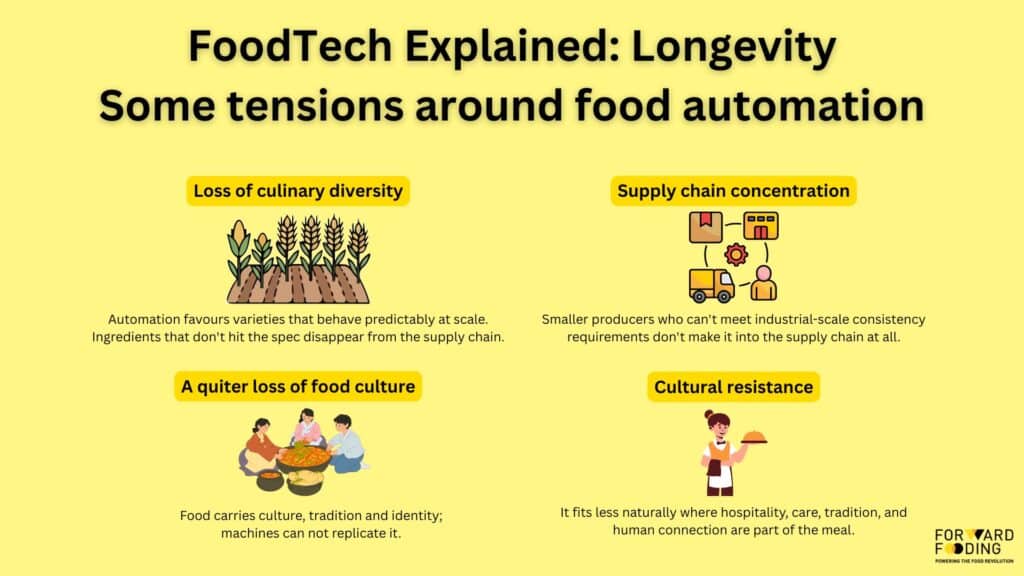
Loss of culinary diversity
The FAO estimates that 75% of the world’s food crop diversity has been lost since 1900. Three crops, rice, wheat, and maize, now provide 60% of all plant-based calories globally. The food system didn’t become this narrow by accident. It became this narrow because industrial processing, distribution, and now automation all favour varieties that behave predictably at scale.
The banana is a useful warning. The Gros Michel, once the dominant export banana, was largely replaced after Panama disease devastated plantations in the mid-20th century. The Cavendish took its place because it worked better for the global supply chain: it was productive, transportable, and uniform. Today, the Cavendish accounts for the overwhelming majority of global banana exports. One variety. One specification.
Supply chain concentration
Standardisation also shapes who gets to supply the system. Robots need ingredients that meet tight specifications: same size, same cut, same moisture, same packaging, same shelf life. Large suppliers are usually better positioned to meet those requirements at scale. Smaller farms, regional processors, and more seasonal or diverse ingredients can be pushed out.
A quieter loss of food culture
No single company decides to make food more boring. It happens gradually, one operational decision at a time. A robot needs a fixed portion. The recipe adjusts around the robot. The supplier adjusts around the recipe. The menu adjusts around what the system can handle reliably. Across thousands of locations, the result can be a food culture that converges around what is easiest to automate.
However, food carries memory, care, identity, improvisation, and craft. A hand-formed dumpling, a family sauce, a seasonal stew, or a cook adjusting a dish by sight and smell all contain forms of knowledge that are difficult to translate into a machine-readable process. Automation can reproduce a task, but it cannot fully reproduce the human meaning attached to that task.
Cultural resistance
This is why automation is more accepted in some contexts than others. In fast casual, vending, airports, hospitals, or high-volume catering, diners may value speed, access, consistency, and price above human interaction. In those spaces, automation can make sense. But in restaurants where hospitality is part of the product, the trade-off is different. A robot can assemble a bowl quickly and consistently, but it cannot notice hesitation, explain a dish with warmth, adapt intuitively to a guest, or create the sense of being cared for. Food is also relationship, tradition, and experience.
What needs to change
The next phase of food automation needs a different starting point. Not “how do we put a robot in the kitchen?” but “what food, workflow, and operating model can actually support automation?”
Co-development and collaboration
The deployments that have worked share something beyond standardised inputs and controlled environments. They were built collaboratively. This means bringing chefs, food scientists, robotics engineers, operators, and supply chain teams into the same design process from the beginning. The food and the machine were designed together, not sequentially.
Standardizing while preserving food culture
Automation-compatible does not have to mean culturally erased. A robot may need a fixed portion, a specific cut size, or a controlled texture. But the food team needs to ask what can be standardised without stripping away flavour, quality, identity, or pleasure.
Better task selection
Not every kitchen task should be automated. Companies need to stop chasing full-kitchen automation and focus on the tasks where automation actually helps: repetitive, high-volume, physically demanding, hard-to-staff, consistency-sensitive tasks.
Therefore, the next phase of food automation will not be won by the company with the best robot. Sweetgreen’s move to hand its Infinite Kitchen to Wonder rather than scale it in-house is a sign of exactly that because the hardest part was never the machine. It will be won by the company that solves the ingredient problem first, builds the supplier relationships that make consistency possible at scale, and does it without narrowing the food system further than it has already been narrowed.
Forward Fooding is the world’s first collaborative platform for the Food & Beverage industry via FoodTech Data Intelligence and Corporate-Startup Collaboration – Learn more about our Consultancy and Scouting Services and our Startup Network.


