Over the last decade I’ve been fortunate enough to witness and actively contribute to the development of the global AgriFoodTech ecosystem and to this very date I’m still quite shocked about how underfunded this ecosystem is. When we look at the global capital inflow in Fintech companies over the last 10 years is approx $1.27T. Our proprietary data from the FoodTech Data Navigator suggests that approx $311B+ have been invested to date in AgriFoodTech companies globally in the same time period. That’s less than 25% of what’s been invested globally to advance finance
Thus, having worked elbow-by-elbow with thousands of FoodTech entrepreneurs, corporate executives and government representatives over the years, I can’t help but notice that FoodTech ran on conviction. The conviction that consumers would pay more, that scale would fix margins, that the market would arrive on schedule. Investors, founders, and the ecosystem around them bet big — and for a little while, after COVID made evident the fragility of our food system and its supply chains, the momentum made the bet look reasonable.
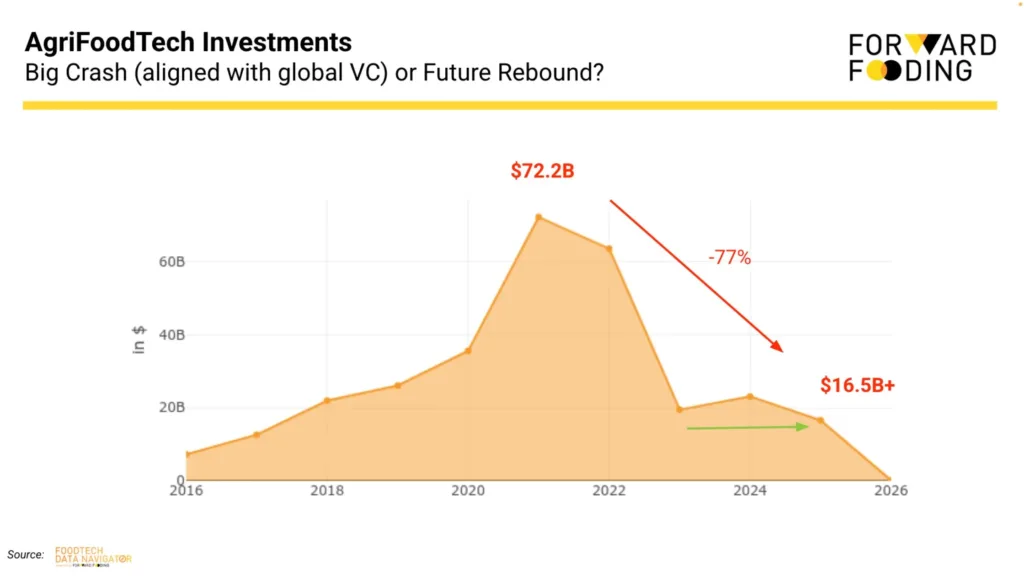
Then it actually didn’t. Roughly $50 billion in capital has been destroyed across the agrifood-climate tech space since 2023: private companies that raised billions and went to zero, public market capitalisations that collapsed 90+% and in many cases entirely. Vertical farms, plant-based meat, cultivated protein, insect facilities, carbon platforms, among others. By 2026, a good chunk of VC portfolios with another me-too of these companies had been written off.
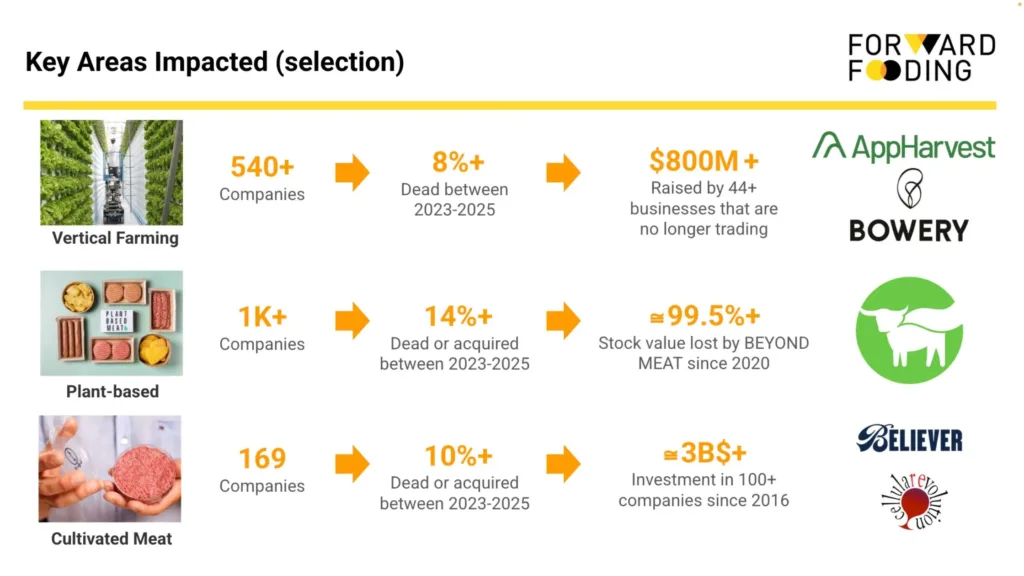
At Forward Fooding, through seven years of data tracking over 30,000 ecosystem actors, our FoodTech Data Navigator has helped us understand and develop a slightly different story, probably not as sexy as the one painted by most media outlets. Global FoodTech investment fell 70% from its previous peak. Entire subsectors that looked like competitive markets in 2021 have been nearly emptied. The correction is real, it is structural, and it is likely not over yet.
But data only becomes useful when it forces honest questions. So: what actually happened? And what does it mean for the next wave?
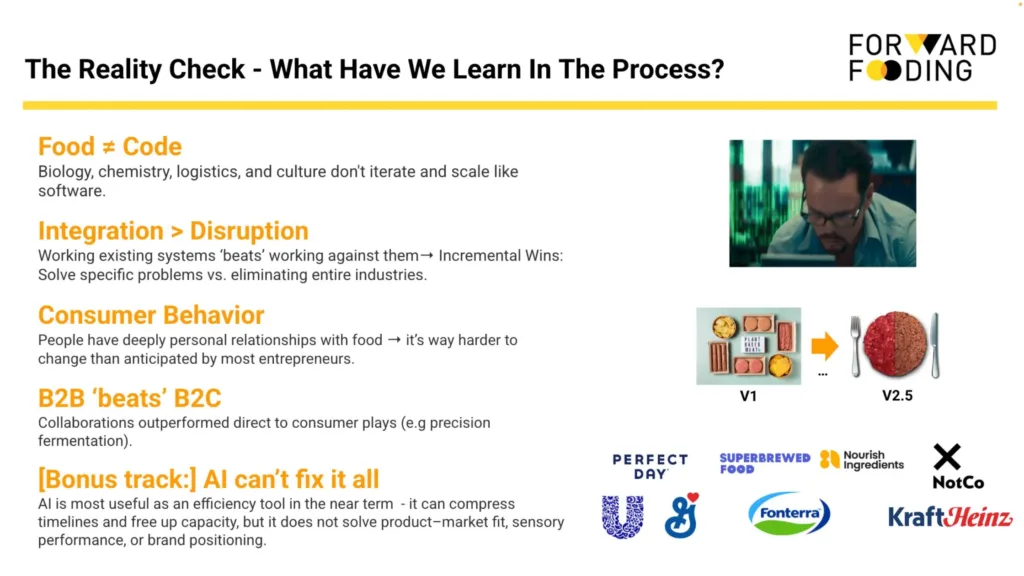
Food Is Not Code
The single most important misunderstanding of the FoodTech boom was categorical. Investors, founders, and the ecosystem around them treated food innovation as if it operated on software timelines. Move fast. Raise big. Scale before competitors. Fix the unit economics later.
Biology, chemistry, and food safety do not work that way. They never did.
The companies that failed did so not because the science was wrong, but because the capital structure was incompatible with how long the science actually takes. Standard VC funds run ten-year cycles with pressure to show returns by year seven or eight. The technologies being funded — cultivated protein, precision fermentation, advanced bioprocessing — require twelve to fifteen years to reach commercial viability. This mismatch was known. It was funded anyway, on the implicit assumption that an acquirer would appear before the clock ran out. When interest rates rose in 2022, the acquirers disappeared.
Our FoodTech 500 keynote put it plainly: food does not function like code. The companies that learned this lesson early survived. The ones that didn’t are the ones now being catalogued in bankruptcy filings and administration notices.
The Four Patterns Behind the Collapse
Across seven years of FoodTech 500 data and ecosystem tracking, four structural failure modes explain the majority of what went wrong. These were perfectly summarised in the article by Eugen Kaprov from The New Bioeconomy:
VC timelines vs. deep tech realities. The 2021 vintage of FoodTech investment may be the worst-performing cohort in venture history for these sectors. Companies that raised at peak valuations got caught in a brutal trap: too expensive to acquire, too cash-hungry for bridge rounds, too diluted to raise again. Founders described being “devastatingly close” to scale when the money ran out. This is not primarily a technology failure. It is a capital structure failure.
Unit economics that never closed. Vertical farms producing lettuce at $3.07 per pound against field costs of $0.65. Insect protein priced two to ten times above soy or fishmeal. Plant-based meat carrying a 20–30% consumer premium during a cost-of-living crisis. One pattern is especially stark: every company that built the “world’s largest” facility before proving unit economics subsequently failed. Every single one. Ÿnsect, Aspire Food Group, Believer Meats, Jones Food Company, AppHarvest — all gone. Superlative scale without proven economics is a death sentence in this industry.
Infrastructure exposure. Vertical farms needed cheap electricity during an energy crisis. Facilities in South Africa collapsed under four-hour rolling blackouts. Singapore operations couldn’t compete with tropical field agriculture. The lesson is almost painfully obvious in retrospect: match your technology to your geography. Eighteen companies and $4 billion in vertical farming losses confirm that it wasn’t obvious enough.
Demand that never arrived. Plant-based meat sales peaked in 2021 and declined every year since. The voluntary carbon market collapsed 61% in a single year. The “ultra-processed” narrative hit just as inflation made sustainability premiums unsustainable. Across at least twenty smaller plant-based brands that disappeared with barely a headline — Bolder Foods, Choppy!, Willicroft, Planetarians — the problem was identical: supply built for demand that existed in pitch decks, not on supermarket shelves.
What the FoodTech 500 Data Adds
Seven years of FoodTech 500 data lets us look forward, not just back.
The structural correction is real, but it is also clarifying. Investment in alternative proteins and delivery platforms that once dominated the space — at one point accounting for 66% of sector funding — has fallen to 38%. That capital is moving toward Ag Biotech, circular economy solutions, soil health, food waste reduction, and the infrastructure layer of the food system. Companies that address genuine supply chain problems rather than consumer behaviour change.
Critically, over 80% of the companies in our current FoodTech 500 are revenue-generating. That figure would have been unthinkable at the 2021 peak. Capital efficiency has replaced growth-at-all-costs as the primary virtue signal for serious founders. The ecosystem is maturing, even as parts of it are still burning.
We also see something encouraging in the diversity data: teams with diverse backgrounds across our most recent cohort are navigating the funding drought more effectively than their counterparts. This matters not just as a moral metric but as a signal of problem-solving sophistication in constrained environments.
FoodTech Wave 3.0: Integration Over Disruption
We’ve described the current moment as the beginning of FoodTech Wave 3.0 — and the contrast with what came before is stark.
Wave 1 was platforms: delivery, discovery, convenience. Wave 2 was disruption: replace meat, replace farming, replace the supply chain. Wave 3 is integration. Work within existing systems. Target B2B before B2C. Build for the infrastructure of the food supply chain, not against it.
The surviving companies share a clear profile: asset-light, B2B-first, backed by patient capital. Precision fermentation ingredients selling to food manufacturers rather than consumers. Plant-based protein repositioned as a health ingredient rather than a meat replacement. Corporate partnerships, industrial pilots, and merger activity are all up. Press release partnerships are down.

Four strategic pillars define what success looks like in this phase:
Patient and blended capital. Traditional venture timelines are structurally incompatible with FoodTech development cycles. The companies that are surviving have strategic co-investors — Cargill, ADM, DSM — who don’t need a seven-year exit. Public-private partnerships and milestone-based funding are not niche financing structures anymore; they are the appropriate tool for the technology. Companies whose cap tables consist entirely of financial VCs should consider this a structural risk.
Pragmatic integration with near-term impact. Sustainability and profitability are not opposing forces, but the sequencing matters. Companies that lead with economic value and build sustainability in as a feature — rather than leading with sustainability and hoping economics follow — are outperforming. The voluntary carbon market collapse is the starkest illustration of what happens when the value proposition depends on policy commitment rather than direct economic benefit.
Leaner regulatory frameworks. Multi-year approval cycles are not a natural law. They are a design choice, and they’re killing viable companies. Better agency coordination, clearer pre-competitive pathways, and regulatory sandboxes for novel food technologies are not nice-to-haves. They are the difference between viable innovation and companies dying in the valley of death.
Meaningful partnerships. The shift is from announcements to outcomes. Industrial pilots with defined milestones. Acquisitions that bring technology inside established distribution networks. The ecosystem is small enough that reputational capital matters: empty MOUs and performative pilot programmes are increasingly visible for what they are.
The Work That Remains
The problem FoodTech was built to solve hasn’t gone anywhere. The global food system still needs to feed a growing population with a shrinking resource base and an increasingly unstable climate. The scientific capabilities to address that problem — precision fermentation, bioactive ingredients, agricultural biotechnology, food waste valorisation — are real and improving. What died was a specific, venture-fuelled, consumer-facing version of how to get there fast.
What remains is harder, slower, and more grounded. It requires founders who understand the difference between a compelling narrative and a proven unit economic. It requires investors with time horizons that match the technology. It requires corporate partners willing to do more than sign an MOU and issue a press release.
The next decade of FoodTech will be built by people who can hold both truths at once: the urgency of the problem, and the patience the solution actually demands.
Forward Fooding is the world’s first collaborative platform for the Food & Beverage industry via FoodTech Data Intelligence and Corporate-Startup Collaboration – Learn more about our Consultancy and Scouting Services and our Startup Network.