52% of consumers worldwide now use probiotics weekly. The global gut-health market is worth $71 billion and is on course for $105 billion by 2030. Supermarket shelves have reorganised themselves around the category: prebiotic sodas, fibre-packed cereal, fermented snacks marketed as mood support. Gut health has become a major lifestyle category before most people understand what the gut actually does. This piece unpacks the science and why the gut influences far more than digestion.
What is gut health
Gut health refers to how well the entire digestive system functions, not just digestion, but the gut lining’s integrity, the balance of trillions of microorganisms inside the tract, and the gut’s ongoing communication with the immune system, metabolism, and brain.
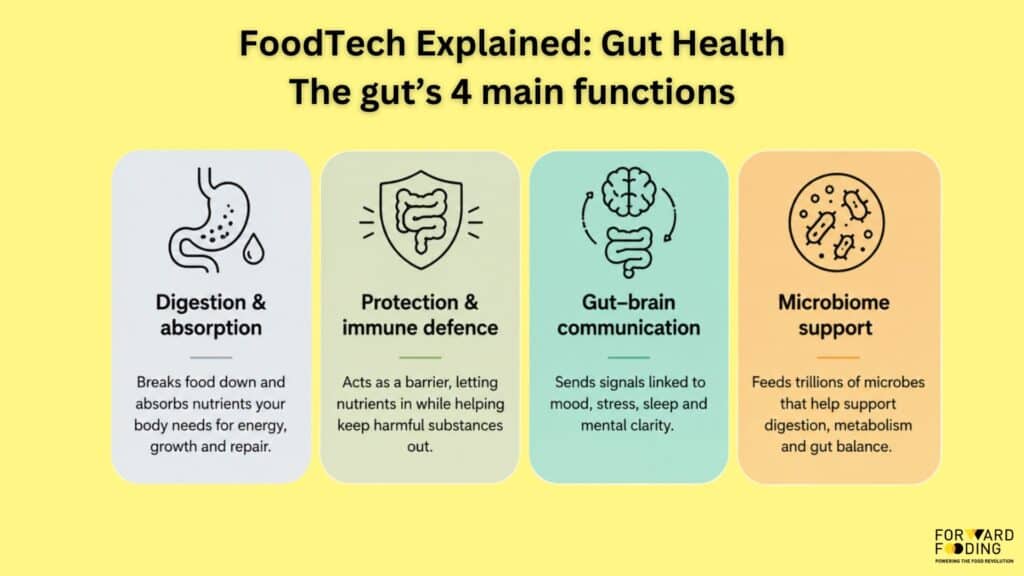
The gut’s core functions
Digestion and absorption. The gut breaks food down with acids and enzymes and absorbs the building blocks, such as amino acids, vitamins, and glucose, into the bloodstream to fuel cell repair and metabolism.
Immune defense. Around 70% of the body’s immune cells sit in and around the gut. A single-cell barrier lets nutrients through while keeping pathogens out, with a dense population of immune cells stationed just behind it.
The gut–brain axis. The gut is wired to the brain through the vagus nerve, and it talks back as much as it listens. It produces up to 90% of the body’s serotonin and helps regulate stress, sleep, and mental clarity.
The metabolic factory. Inside our large intestine lives a community of trillions of microscopic organisms, mostly bacteria, but also fungi and viruses. These ferment the fibers your own cells can’t digest into short-chain fatty acids, which are the compounds that lower inflammation, steady blood sugar, and even synthesize vitamins like B12 and K.
Microbiota vs microbiome: the distinction behind the buzzword
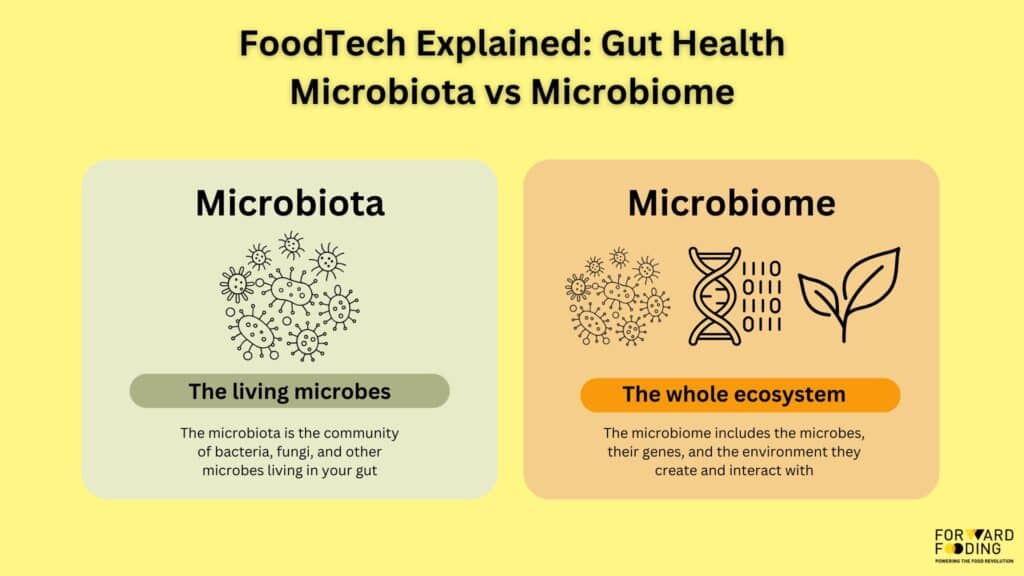
Microbiota” and “microbiome” are used interchangeably in wellness marketing. They mean different things, and the gap between them shapes how ingredient design actually works. Think of your gut as a massive, sold-out music festival.
- The Microbiota is the festival crowd: The microbiota refers to the actual physical creatures living in your gut. We’re talking about a staggering roster of bacteria, fungi, viruses, and archaea.
- The Microbiome is the entire festival: The microbiome is a much bigger concept. It includes the microbiota (the people), but also their genes, what they are actively doing, and the entire environment they live in. The crowd, plus what they’re eating and doing, the stage they’re responding to, and the conditions they’re living through.
Context is everything
Marketing has made us think that we just talk about bad or good bacteria. In a real, living microbiome, microbes are entirely context-dependent. Whether a specific bacterium is helpful or harmful depends on four crucial variables:
- Abundance: A small group of a certain bacterium might be great for breaking down fiber. But if that same group multiplies x100, they might start causing severe bloating or inflammation.
- Location: A microbe that is an absolute superstar inside your large intestine can become a dangerous pathogen if it migrates up into your small intestine or leaks into your bloodstream.
- Function: It’s less about who the bacteria are and more about what they are eating and producing. A “good” microbe fed on a poor diet might stop producing beneficial compounds and start acting up.
- The Individual: Everyone’s microbiome is as unique as a fingerprint. A strain of bacteria that optimizes metabolism for Person A might do absolutely nothing, or even cause discomfort, for Person B. For instance, take inulin (chicory root fiber), the star ingredient in almost every prebiotic soda. For Person A, their specific bacteria feast on it, lowering inflammation and stabilizing blood sugar. But for Person B, who has a slightly different microbial mix, that same fiber acts like an absolute bomb, triggering instant gas and painful bloating. Same “healthy” soda, opposite biological outcomes.
The gut–brain connection
If you’ve ever felt “butterflies” in your stomach before a big presentation, or had your appetite completely vanish after receiving bad news, you’ve experienced the gut-brain axis in real-time.
Our microbes are constantly creating metabolites, short-chain fatty acids, and neurotransmitters. These chemicals enter the bloodstream or interact with local nerve endings, acting as status updates for the central nervous system.
Mood and the gut: serotonin myth vs. reality
The wellness industry loves one statistic: “90% of the body’s serotonin is made in the gut.” From there, the marketing leaps to a tidy promise: buy our probiotic, boost serotonin, cure anxiety.
The reality is more nuanced. Serotonin made in the gut is used locally, to regulate motility and signaling. Because of the blood–brain barrier, it can’t cross into the brain to lift your mood; the brain manufactures its own supply. What a healthy microbiome does is send the brain the raw materials, including amino acids like tryptophan, and produce short-chain fatty acids that help maintain that barrier and protect the brain from inflammation.
That connection is now an innovation space. In Forward Fooding’s Food Data Navigator, 132 companies sit at the intersection of gut and brain health. The leading edge is psychobiotics, which are probiotics or prebiotics designed to influence mood through the gut–brain axis. Most activity is still in supplements and functional drinks, but Unilever’s partnership with Holobiome, an MIT spinout, signals where it’s heading: from broad “calm” and “focus” claims toward clinically studied microbial ingredients built into mainstream food and drink.
What shapes the gut microbiome?
Our microbiome is not a static genetic blueprint inherited at birth and locked in place forever. Because our microbiome responds to our daily life, no two are identical. Even identical twins, who share 100% of their human DNA, share only about 30% of the same gut microbes.
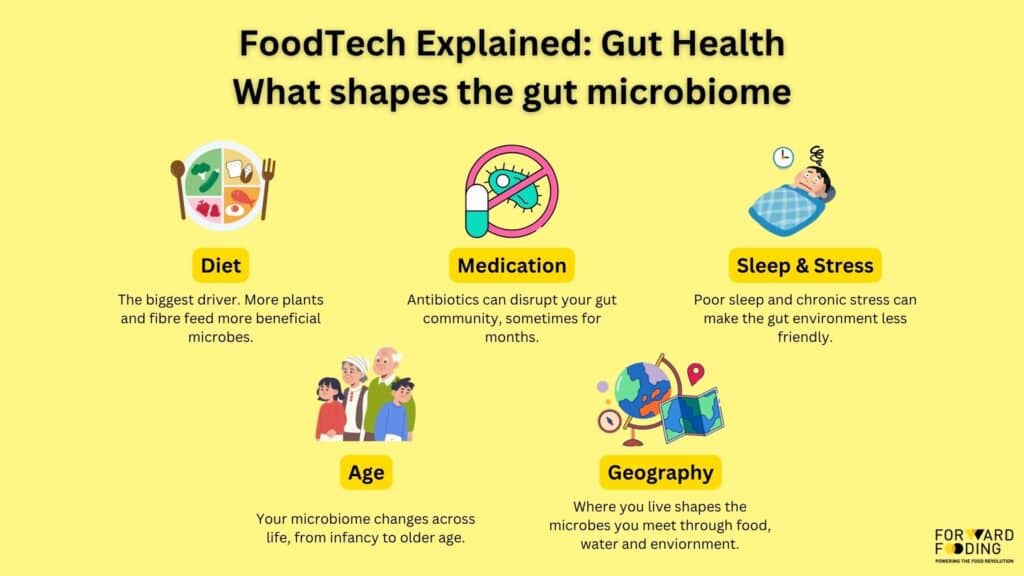
Primary levers shaping the gut microbiome:
- Dietary patterns: This is the single most powerful tool you control. Microbes eat what you can’t digest, specifically complex carbohydrates and dietary fiber. A diverse diet rich in different plants acts like an all-you-can-eat buffet for a wide variety of good bacteria. Conversely, a steady diet of highly processed foods lacking fiber effectively starves out those beneficial strains, allowing less helpful, inflammatory microbes to dominate.
- Medication: Antibiotics are modern miracles, but they are also harmful for our microbiome. A single dose can wipe out vast swaths of your beneficial bacteria, and while some strains recover quickly, others can take months to bounce back.
- Sleep and stress: High stress levels release cortisol, which damages the gut lining and alters motility (how fast food moves through you). When you are chronically exhausted or stressed, your gut environment becomes hostile, degrading microbial diversity.
- Age: The foundation of your microbiome is laid down in the first few years of life, heavily influenced by how you were born (vaginal delivery vs. C-section) and early infant nutrition. Your microbiome matures and stabilizes during adulthood, but as you hit old age, it naturally begins to lose diversity, which is often linked to a weakening immune system.
- Geography: Where you live dictates your microbial exposure. The soil, the local water supply, the air quality, and the regional food supply all introduce different environmental microbes into your system.Someone living in an urban apartment in New York will have a vastly different baseline microbiome than a farmer in rural Italy, simply due to the microbes they interact with daily.
The gut health category in food
Gut health is no longer limited to yogurt or supplements. It has become a broad food and drink category, spanning fibre-rich snacks, probiotic beverages, functional powders, fermented foods and increasingly targeted microbiome products. Product innovation is accelerating: global food and drink launches carrying a gut-health claim increased by 61% between 2024 and 2025. According to Forward Fooding’s Food Data Navigator, the category includes 532 startups. What began as a market built around probiotics is now expanding into a much wider set of ingredients and technologies.
The mainstream gut-health ingredients: The biotics matrix
| Biotic | What it actually is | Foodtech applications & examples |
|---|---|---|
| Probiotics | Live microbes. Beneficial bacteria or yeast ingested to reinforce your existing gut microbiome. | Moving beyond yogurt. Expanding into dairy-free drinks, powders, gummies, bars and wellness shots. Protective coatings, freeze-drying and targeted delivery keep cultures alive through manufacturing and digestion. The next wave: multi-strain products, microencapsulated cultures and “next-gen” strains (e.g. Akkermansia) targeting metabolic health, gut-barrier support or blood-sugar management, not just broad digestive wellness. e.g. Pendulum Metabolic Daily. |
| Prebiotics | Food for the microbes. Non-digestible plant fibres that pass through the upper gut unchanged to fuel beneficial bacteria. | Fibre as a functional platform. Used beyond digestive claims: adding fibre, reducing sugar, improving fullness and supporting steadier blood-sugar responses. Formats include sodas, bars, snacks, gummies, meal-replacement drinks and baked goods. The formulation shift is toward precision fibres, highly soluble, low-impact options that can be added at useful levels without making drinks gritty or products hard to digest. e.g. Olipop, Poppi, Supergut, Olly. |
| Postbiotics ⚡ Fastest-growing |
Microbe byproducts. Not alive. The beneficial compounds left after bacteria ferment food. | Ultra-stable formulation advantage. Already inert, postbiotics don’t require refrigeration, survive pasteurisation, and have long shelf lives. Companies use them to add gut benefits to hot teas, shelf-stable clear juices and baked goods, categories probiotics can’t reach. e.g. Superbrewed SB1 postbiotic protein for shakes and bars. |
| Synbiotics | The all-in-one package. A probiotic and its preferred prebiotic food, co-formulated to help the microbe survive and thrive. | Synergistic formulations. Rather than hoping a probiotic finds fuel in the gut, companies design the strain, fibre, dose and delivery format together from the start. e.g. Seed DS-01 Daily Synbiotic. |
Case studies: how the category is taking shape
Biomel (United Kingdom | $7.6M raised | Series A)
- London-based plant-based gut-health brand making dairy-free probiotic drinks, powders, and fibre-focused products.
- In 2023, Biomel secured a £5.5M investment from Iris Ventures to expand production capacity and support further growth.
Supergut (United States | $33.1M raised | Series B)
- US functional-nutrition brand building prebiotic fibre into powders, shakes, and snack bars, with a strong link to metabolic health and the emerging GLP-1 nutrition conversation.
- The company raised a Series B round in March 2025, led by Full Frame Growth Partners. It reported 172% year-on-year growth and had expanded into more than 5,000 physical retail locations, including Target, Sprouts, GNC and Vitamin Shoppe.
ZBiotics (United States | $48.9M raised | Series A)
- San Francisco-based synthetic-biology company developing genetically engineered probiotics designed to perform specific functions inside the gut. Its first product, Pre-Alcohol, uses engineered Bacillus subtilis to produce an enzyme that breaks down acetaldehyde in the gut. Its newer Sugar-to-Fiber product is designed to convert dietary sugar into fibre through a microbial enzyme.
- Raised a $12M Series A in 2024, led by Springtide Capital, to expand retail and develop further engineered-probiotic applications. The company has sold more than 8 million bottles of its first product. ZBiotics is the clearest case study for the “next-generation probiotic”
Some examples of next-generation ingredients & technologies for gut health
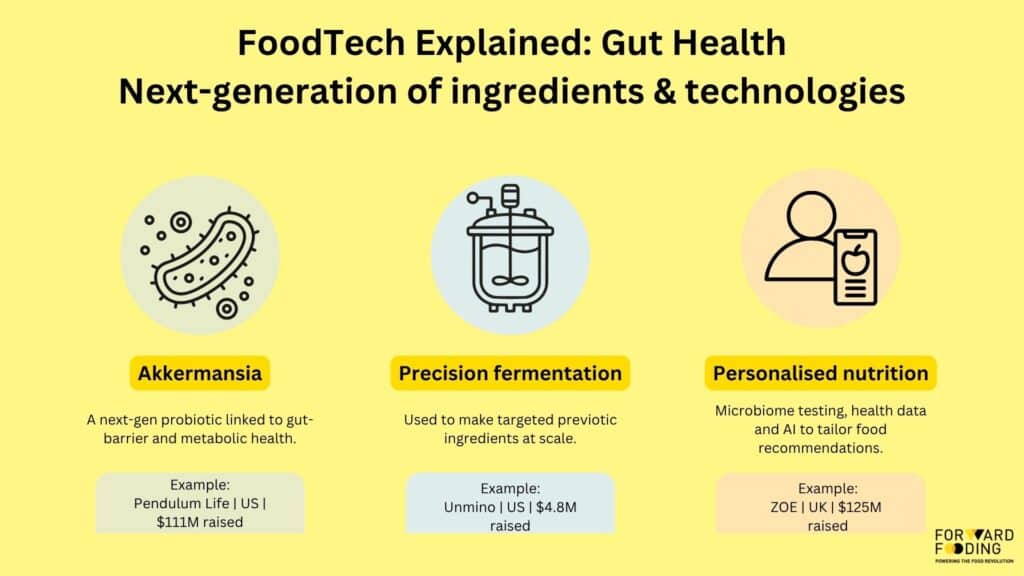
The next phase of the category is moving from broad digestive-health positioning toward more targeted microbial ingredients, clinical research and personalised recommendations.
- Akkermansia muciniphila. Most probiotics use familiar microbes like Lactobacillus or Bifidobacterium. Akkermansia is different: it lives in the gut’s protective mucus layer and appears to help the body renew it, maintaining the barrier that keeps harmful substances out of the bloodstream. Low levels are linked to obesity, insulin resistance and type 2 diabetes, and early human studies suggest supplements may improve some metabolic markers, though the evidence is still developing. That promise made it the best-known “next-generation probiotic”, and in 2025 Danone acquired The Akkermansia Company. Pendulum Life (US | $111M raised | Series C) pairs a patented live Akkermansia strain with prebiotic fiber for gut-lining and metabolic support; Fonterra added a $10M strategic investment in 2023.
- Precision fermentation. This route unlocks ingredients that were hard to produce at scale, notably human milk oligosaccharides (HMOs), complex carbohydrates in breast milk that selectively feed beneficial microbes. Ummino (US | $4.8M raised | Seed) uses precision fermentation to make Hummino, a bio-identical prebiotic built on lactosamine found in HMOs, aimed not at infant formula but at adult gut-health products.
- Personalized nutrition. Because no two microbiomes respond alike, services are combining microbiome testing, health data and machine learning to tailor advice. ZOE (UK | $125M raised | Series D) has built a dataset of 300,000+ gut-microbiome profiles and served 190,000+ paying customers, raising $11.7M in a 2025 Series D.
The Foodtech Opportunity
For FoodTech, to capture a market scaling toward $105 billion by 2030, the opportunity is to turn that complexity into products people can understand and use every day.
- Make the benefit clear: Shift from vague, abstract promises (e.g., “supports gut health”) to tangible everyday outcomes consumers can actually measure, such as stable energy or better sleep.
- Everyday relevance: The most relevant formats are likely to be the ones consumers already buy and enjoy: sodas, coffees, breakfast products, snacks, smoothies and meal-replacement drinks.
- Move from single ingredients to smarter combinations: The next generation of products will not rely on one probiotic strain or one fibre claim. It will combine different tools, fibres, live microbes, postbiotics, lower-sugar systems, protein and personalised guidance to address several needs at once.
- Prove that it works: The brands that win will be the ones that make the science feel simple, useful, and worth coming back to.
Success will be about building functional products that keep a trillion-microbe ecosystem running.
Forward Fooding is the world’s first collaborative platform for the Food & Beverage industry via FoodTech Data Intelligence and Corporate-Startup Collaboration – Learn more about our Consultancy and Scouting Services and our Startup Network.