Milk is more than a white liquid. It is a finely tuned mix of proteins, fats, and sugars that makes cheese stretch, yoghurt set, and a flat white foam properly. Precision fermentation lets companies make some of those molecules without a cow, as microbes are engineered to produce specific milk molecules in fermentation tanks. The approach is not new. Chymosin, the enzyme (molecule) that curdles milk into cheese, has been made this way since 1990 and now supplies most of the world’s rennet. What is new is the range of molecules now in play. Companies are going after whey, casein, milk fat, lactoferrin, and human milk oligosaccharides (HMOs), the molecules that plant-based dairy has never managed to replicate.
What is Precision-Fermented Dairy?
Precision fermentation is a production method that uses microorganisms, such as yeast or fungi, as tiny factories. Scientists give these microbes the genetic instructions to make a specific ingredient, then grow them in fermentation tanks, similar to those used for brewing beer or making yoghurt.
Dairy precision fermentation applies this process to dairy molecules. Companies use microbes to produce the same cow proteins in fermentation tanks. These ingredients can then be combined with fats, sugars, minerals and water to create products that deliver some of the taste, texture and performance of dairy without relying on conventional animal farming. The U.S. Food and Drug Administration (FDA) issued its first GRAS (“generally recognized as safe”) clearance for a fermentation-made dairy protein in 2020, covering Perfect Day’s whey protein, made using the fungus Trichoderma reesei.
Why Microbes, Not Cows
Beyond removing animals from the equation, the core promise of precision fermentation lies in resource efficiency. Traditional dairy farming is incredibly resource-intensive: a cow requires massive amounts of land, water, and caloric input just to maintain its biology, with only a fraction converted into milk protein. Microbes, by contrast, act as highly optimized, hyper-targeted bioreactors. They can be engineered to produce a single target molecule and little else, which makes them far more efficient converters. For products already on the market, the efficiency gap is measurable. Perfect Day’s whey protein, the one covered by the FDA’s 2020 clearance, has been assessed in an ISO-conformant, third-party-validated life cycle assessment: up to 97% lower greenhouse gas emissions, up to 99% less blue water consumption and up to 60% less nonrenewable energy use than the protein in conventional milk.
The Milk Molecules Precision Fermentation Can Make
Plant-based vs Precision-Fermentation
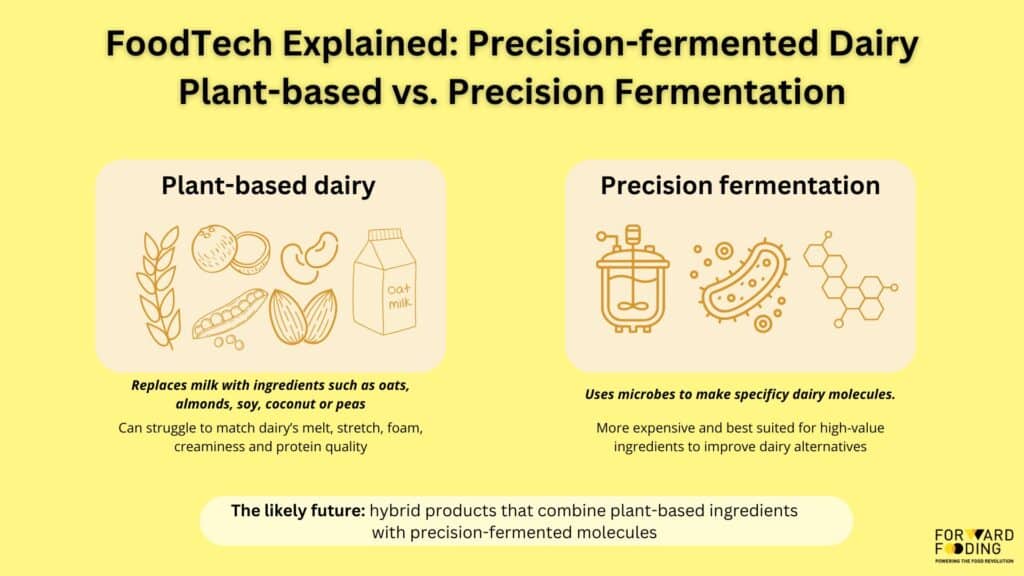
Both approaches aim to reduce reliance on conventional dairy, but they start from very different places. Plant-based dairy replaces milk with ingredients such as oats, almonds, soy, coconut or peas. These ingredients are cheap and familiar and reproduce dairy’s taste, texture and appearance in everyday milks, yoghurts and creamers.
However, plants do not naturally contain the proteins that give dairy its distinctive functionality. As a result, plant-based products often struggle to deliver the melt, stretch, foam, creaminess, and protein quality consumers expect.
Precision fermentation addresses exactly this gap. It is likely to become a high-value ingredient layer: adding the proteins or fats that make products perform more like conventional dairy, while plant-based ingredients will provide the base, volume, and affordability.
Precision Fermentation for Dairy Startup and Scaleup Landscape
According to Forward Fooding’s Food Data Navigator, precision fermentation remains a smaller and more specialised ecosystem than dairy alternatives overall. Across the wider precision-fermentation sector, 202 companies grew at a 21.1% CAGR between 2020 and 2025, while just 34 focus specifically on dairy applications, growing at a 10.95% CAGR.
By comparison, dairy alternatives include 481 companies and grew at a 26.07% CAGR over the same period. But this larger market is overwhelmingly consumer-facing: 421 companies operate in B2C, compared with only 40 in B2B.
The contrast points to two different models. Plant-based dairy has largely been built around consumer brands and finished products and precision-fermented dairy is still a smaller, B2B earlier-stage ingredient play.
B2B Ingredient Pioneers
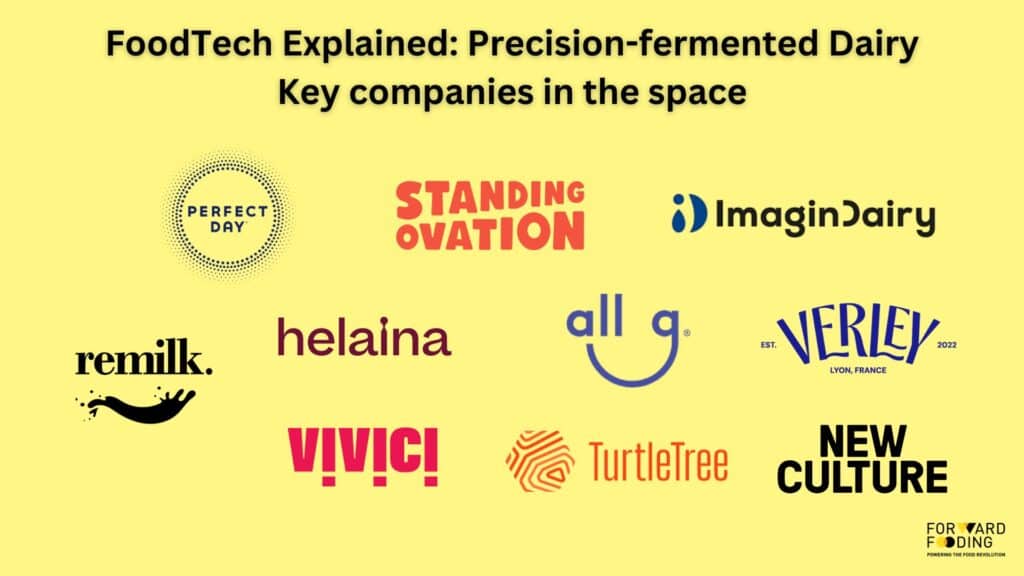
Whey protein: Perfect Day (United States | $828M raised | Mature)
- Precision-fermentation pioneer producing dairy-identical whey proteins for food and beverage companies.
- Its ProFerm ingredient is designed to replicate the solubility, foaming and nutrition of conventional whey without cows. Perfect Day has built major partnerships with Bel, ADM, Unilever, Nestlé, Mars, Brave Robot, and My Protein, and is now focused on industrial scale-up, including a planned India production ramp from late 2026.
Casein: Standing Ovation (France | $23.4M raised pre-2026 round | Scale-up)
- French company producing precision-fermented casein, the protein behind cheese melt, stretch and structure. Its Advanced Casein™ targets dairy and cheese applications where plant proteins still struggle.
- Standing Ovation raised €30M in 2026 and is working with Bel Group to produce casein from acid whey, positioning fermentation as a complement to conventional dairy rather than only a replacement.
Full dairy systems: Imagindairy (Israel | $30.2M raised | Scale-up)
- Israeli company developing animal-free dairy proteins, initially focused on whey. Rather than selling a single molecule, Imagindairy is building toward complete dairy systems that combine precision-fermented proteins with fats, carbohydrates and minerals for milk, cream cheese and other formats.
- The company has received FDA clearance for its proteins and is moving toward commercial launches with Strauss.
Other leading companies in the space
Remilk (Israel): Makes dairy-identical milk proteins using yeast fermentation, enabling cow-free milk, cheese, yoghurt and other dairy products at commercial scale.
Helaina (United States): Produces bio-identical human lactoferrin through precision fermentation, targeting next-generation nutrition and infant-formula applications.
Vivici (Netherlands): Commercialises precision-fermented functional proteins, including lactoferrin and dairy proteins, for health, performance and nutrition brands.
All G Foods (Australia): Develops precision-fermented bovine and human milk proteins, with a focus on lactoferrin and ingredients for early-life, functional and active nutrition.
TurtleTree (Singapore): Produces LF+, an animal-free lactoferrin made through precision fermentation for nutrition, wellness and functional-food applications.
Verley (France): Develops functional animal-free whey proteins through precision fermentation, designed for performance nutrition, beverages, fresh dairy and cheese applications.
New Culture (United States): Makes animal-free casein for mozzarella that is designed to deliver the melt, stretch and taste of conventional cheese, initially targeting pizzerias.
The frontier: human-identical milk components
Precision fermentation is now moving past whey and casein toward human-identical milk components such as lactoferrin and human milk oligosaccharides (HMOs). These are the highest-value targets in the field, and they raise questions that bulk dairy proteins do not, from stricter regulatory scrutiny in infant formula to the limits of matching a living, dynamic system. Lactoferrin in particular is having a moment: conventional supply is extracted from cow’s milk at high cost, while a wave of precision-fermentation companies now holds US clearances and corporate backing. We go deep on it in the next edition of our Novel Ingredients Series.
The roadmap to market
Precision-fermented dairy has proven it can make dairy proteins without cows. The harder question is whether it can make them cheaply, at scale and in products people want to buy.
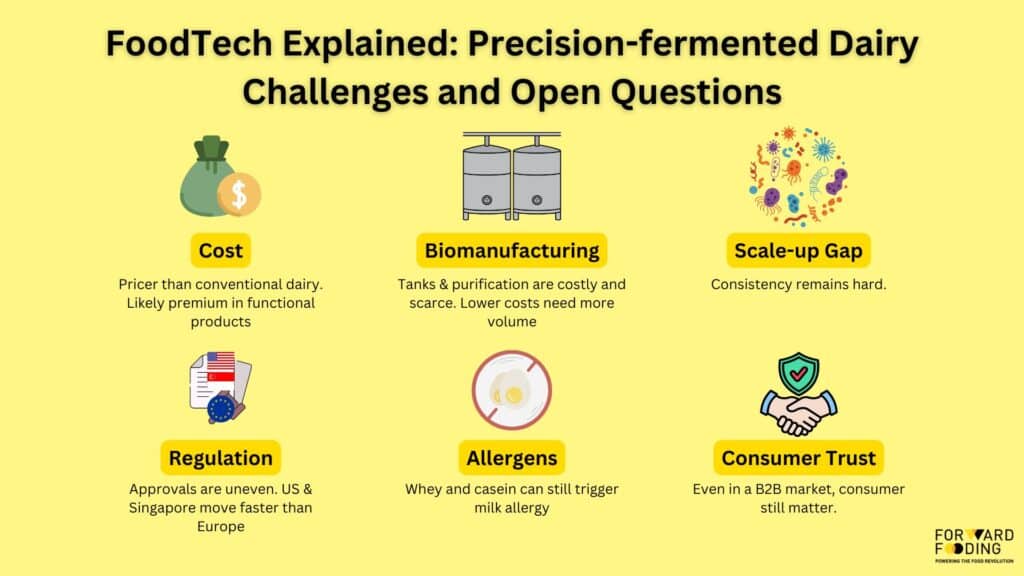
- The biomanufacturing bottleneck: Fermentation tanks, feedstocks and purification systems are expensive and limited. Companies need large volumes to lower costs, but need demand first to justify building that capacity.
- Cost: It is still difficult to compete with conventional dairy on price. The strongest early opportunities are likely to be premium or functional products where better foam, melt, protein quality or lactose-free positioning can justify a higher price.
- The scale-up gap: Keeping microbes productive and preventing contamination at industrial scale remains a massive hurdle. Furthermore, critics rightly point out that if microbes are fed first-generation agricultural sugars (like corn or cane) and powered by fossil-fuel grids, the environmental benefits shrink. To counter this, scale-ups are pivoting toward circularity and next-generation feedstocks. For instance, France’s Standing Ovation is utilizing agricultural side-streams like acid whey, a byproduct of traditional cheese-making, to feed their microbes, turning a waste problem into a circular solution.
- Regulation: The US and Singapore have moved faster than many other markets. Europe remains slower and more complex, creating a patchwork where an ingredient may be approved in one country but unavailable in another.
- Allergens: Animal-free does not mean allergen-free. A fermentation-made whey or casein protein can still trigger a milk allergy because it is still the same protein.
- Consumer trust: Precision-fermented dairy is mainly a B2B ingredient today, so most consumers will meet it inside another product, cheese, ice cream, a protein shake, rather than choosing it off a shelf by name. That shifts the trust question from the product to the label. In March 2026, the EU banned the use of “meat” and 31 related terms for fermentation-enabled, plant-based and cultivated products, despite consumer surveys showing support for keeping them. How precision-fermented dairy gets described on pack, not just how it performs, will decide whether shoppers trust it.
Forward Fooding is the world’s first collaborative platform for the Food & Beverage industry via FoodTech Data Intelligence and Corporate-Startup Collaboration – Learn more about our Consultancy and Scouting Services and our Startup Network.