The world’s protein challenge is no longer about swapping animal protein for plant protein. Instead, the food industry is set to face a growing, aging population that needs nutrient-dense, low-impact foods that are easy to add to everyday meals, a task that’s proving harder to achieve as climate challenges shrink arable land and water supplies.
That is the belief by which Wim de Laat founded Dutch ingredient company The Protein Brewery in 2020, which proposes that the solution lies in its nutritious whole-food mycelium ingredient Fermotein®. Under CEO Thijs Bosch, the company is reaching milestones that could push mycelium fermentation into the mainstream: the European Commission authorized its Rhizomucor pusillus mycelium as a novel food, an €18M Series B extension funds scale-up toward 2,000 MT, and the first Fermotein®-containing ready-to-mix and ready-to-drink products will land on U.S. shelves later this year.
We sat down with Thijs to talk through the regulatory pathway, the balancing act of funding, scale-up and commercial traction, and what it takes to turn a novel ingredient into a quiet staple for healthy aging.
This interview has been edited for clarity and concision.
From Vision to Whole-Food Mycelium
Forward Fooding: What is the mission of The Protein Brewery and what impact do you aim to generate at the food-system level?
Thijs Bosch: At the food-system level, we target three dimensions. Nutrition-wise, we want people—especially those in mid-to-later life—to get complete protein, fiber, and bioactives from one ingredient without changing their diets. Environmentally, our screening LCA shows Fermotein® delivers a substantially lower CO₂, land, and water footprint than dairy proteins at scale. Structurally, we’re proving that biomass fermentation can sit alongside agriculture as a mainstream, locally-produced source of nutritious ingredients.
The company’s mission is to future-proof nutrition. And Fermotein® is their answer: a minimally processed, whole-food mycelium that delivers 50% complete protein, 30% prebiotic fiber, essential micronutrients, including magnesium, zinc, choline, and B vitamins, and naturally concentrated spermidine. That nutrient profile fundamentally shapes The Protein Brewery’s commercial strategy.

The Protein Brewery CEO, Thijs Bosch
Forward Fooding: Which target consumer segments are prioritized for the initial commercial rollout, and why?
Thijs Bosch: Our core focus is active nutrition with a healthspan lens, and within that, the segments we prioritise are longevity, gut health, weight management, and performance (muscle). We lead with longevity-oriented active nutrition for a practical reason: those brands and consumers value what makes Fermotein® distinctive: the combination of complete protein, prebiotic fiber, and naturally concentrated spermidine in a whole food. They have a high willingness to formulate around a genuinely differentiated ingredient.
Early commercial traction confirms this. Of our most active customer prospects, the majority sit at the crossover of longevity and active nutrition, and the most relevant applications are ready-to-mix powders, bars, and supplements. The metabolic-health angle is increasingly relevant too. As GLP-1 therapies become more widespread, appetite is suppressed, and meaningful nutrition must fit into smaller portions, which favors nutrient-dense ingredients that deliver protein and fiber together.
With EU Novel Food authorization now secured, our European rollout after the summer strategically targets powders, bars, and supplements.
Forward Fooding: What core impact do you aim to achieve by making Fermotein® a staple ingredient for the aging population?
Thijs Bosch: Our hope is that Fermotein®, through partnerships with health and wellness brands, becomes genuinely accessible for everyone. We recently began working with a Swiss brand targeting the middle market: people aged 30 and up, on an average income, who recognize that their body is changing and want foundational nutrition that lets them keep doing the things they love.
Thijs points out that Fermotein® will not stop aging. It is, after all, inevitable. But its negative health effects can be meaningfully mitigated by excellent everyday nutrition, something which Fermotein® can deliver in convenient formats for everyday people.
Funding the Scale-Up: Capital, Capacity and Commercial Traction
The Protein Brewery’s annual capacity is fully booked for the year, at 60MT. But booked capacity is one thing; paying for the next round of it is another.
Forward Fooding: How do you track and ensure that annual sales volume bookings correlate with actual production ramp-up?
Thijs Bosch: We are investing in digital infrastructure so that commercial bookings and production capacity sit in one connected view rather than in separate spreadsheets.
Operationally, we execute against disciplined sales-and-operations planning: a rolling forecast that reconciles contracted off-take and the active pipeline against committed capacity, so we can see early when demand and supply are drifting apart and act on it. Because much of our near-term volume is locked in through supply contracts, the planning problem is less about chasing uncertain demand and more about phasing capacity to meet commitments, while keeping enough headroom for the pipeline of customers still developing concepts.
That operational rigor hasn’t gone unnoticed by the industry, either, as the company recently closed a significant funding round.
Forward Fooding: Following up from the €30M Series B financing in 2025, how will the €18M Series B top-up from ABN AMRO be allocated across your business?
Thijs Bosch: We have just closed an €18M Series B Extension, led by the incoming ABN AMRO Sustainable Impact Fund and joined by our existing investors Invest-NL, Novo Holdings, Madeli, and the Brabant Development Agency. We deliberately expanded the round beyond its initial target on the back of strong investor demand, and it brings our total funding raised to date to more than €70M.
The capital is deployed across four areas. The largest share goes to production scale-up, towards over 2,000 MT, together with the operators, training, and quality systems. Second is the commercial push into Europe after the summer, now that EU authorization is secured, with a primary focus on active nutrition, ready-to-mix powders, and nutritional bars. Third, we continue to invest in the science behind Fermotein®’s longevity-promoting benefits. Fourth, we are funding R&D to develop new SKUs and product formats, as well as towards regulatory dossiers for further markets, with UK authorization expected later this year and submissions advancing in Canada, Australia, New Zealand, and India.
Aligning capital with real demand is a hard discipline, and it’s one Thijs says is built directly into how the company plans.
Forward Fooding: How are you sequencing funding, scale-up and commercial traction to ensure balanced growth?
Thijs Bosch: We try to keep three things moving in lockstep. The discipline starts with our technology. Because our fermentation is non-sterile and runs on a proprietary strain that thrives at high temperature and low pH, we avoid the heavy capital of sterile fermentation, which means each increment of capacity is far less expensive to add. That lets us scale in stages tied to demand rather than betting on a single large plant.
On the commercial side, we scale into contracted volume; our 2026 capacity is already committed to customers in the United States, we have built a pipeline of initial active nutrition customers across the EU and UK, and we have established a full supply chain from fermentation to finished product. Funding is sequenced against those same milestones: the €18M Series B Extension releases capital as we hit capacity and commercial targets. The aim is balanced growth where capacity, demand, and capital reinforce each other instead of one outpacing the others.
None of that scaling happens alone, with Thijs pointing out which parts of the value chain The Protein Brewery owns and which it deliberately leaves to partners.
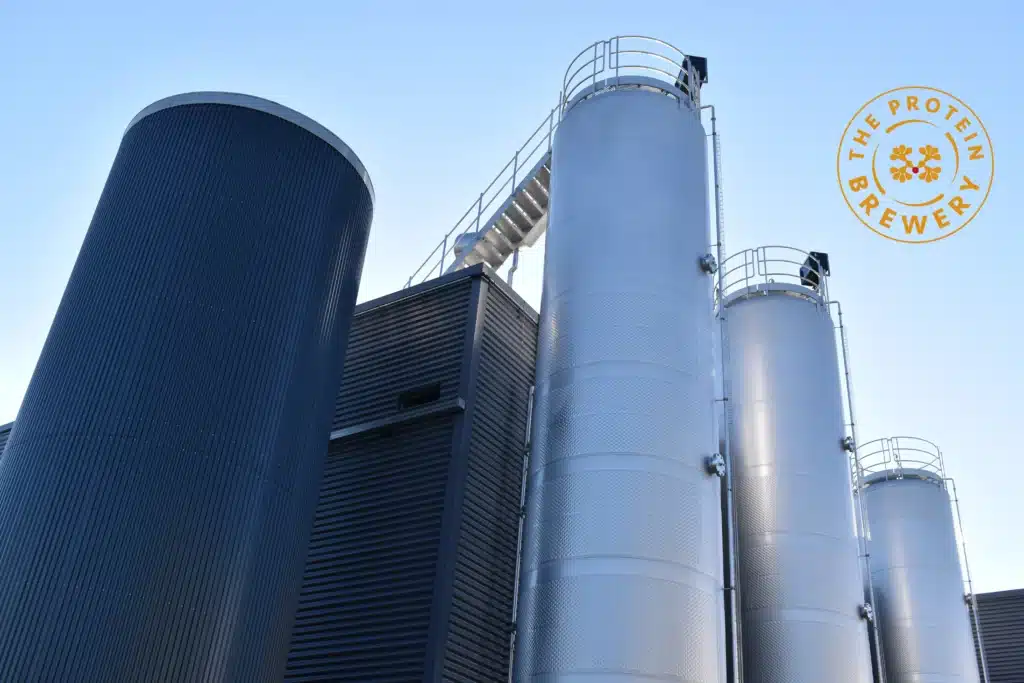
The Protein Brewery’s fermentation tanks
Forward Fooding: In your view, what role do partnerships and collaborations with large corporations play in reshaping the food system?
Thijs Bosch: We operate as a B2B ingredient innovator; we own the science, the strain, the regulatory approval, and the fermentation process, but we don’t make consumer-ready products. That work belongs to our partners: brand owners who know their consumers, contract manufacturers who scale execution, and distributors in the U.S. and Singapore who navigate regional markets. Large corporations bring distribution reach, formulation expertise across categories, and the commercial discipline to move an ingredient from pilot to meaningful market share. We bring the ingredient, the scientific proof, and the willingness to shoulder regulatory risk. When those capabilities meet on clearly defined terms, change happens faster than either side could achieve alone.
Forward Fooding: Which types of partner relationships are most critical for scaling distribution globally, particularly in the U.S. and Singapore markets?
Thijs Bosch: The partners that matter most are the ones aligned with us on vision and values, not only on commercial terms, because scaling a novel ingredient takes patience on both sides. In the U.S., we are fortunate to work with a distribution partner who understands the nutritional case for Fermotein® and shares it with their own brand customers. They have been genuinely patient as we scaled and worked through production challenges, and there is real confidence that we will produce reliably. They have placed an early bet on a first-of-its-kind ingredient. That kind of partner is the most valuable relationship in a young category.
With EU authorization now secured, we can supply European brands directly from our Netherlands factory, which opens a new set of partnerships closer to home.
Crossing the Regulatory Finish Line in Europe
That direct European supply is only possible because of a regulatory milestone years in the making.
Forward Fooding: What is the significance of the European Commission’s adoption of your R. pusillus mycelium ingredient into legislation?
Thijs Bosch: This is a genuine milestone, and not only for us. The European Commission has adopted the draft Implementing Regulation authorising Rhizomucor pusillus mycelium as a novel food and adding it to the EU list of authorised novel foods. That makes Fermotein® the first EU-grown novel mycelium cleared under the EU Novel Food Regulation. The decision follows a positive scientific opinion from the European Food Safety Authority in December 2025. The regulation has now been published in the Official Journal; it enters into force twenty days later, which will happen at the end of July.
Two things make this more than a single approval. First, it comes with five years of exclusivity on the scientific data behind our safety dossier, on top of our patented production process, which protects the position we have built. Second, the Commission agreed to designate the ingredient as “Rhizomucor pusillus mycelium” rather than a more technical “biomass powder” description, which gives European formulators and consumers clear, accurate language for back-of-pack labelling.
Being first also carries a responsibility to shape the category. We want to set the nutritional tone for mycelium, the broader space many still call “mycoprotein,” so that it grows beyond its meat-replacer origins and is recognised as a highly nutritious whole-food rich in protein, fiber, and fungi-specific bioactives. Europe is our home market, and being able to supply European customers directly from our Dutch factory is a turning point for the company.
That milestone didn’t happen by accident. It reflects a deliberate strategic choice, made years earlier, about which regulatory door to walk through first.

Fermotein® “Shake” and “Biome Bar” by The Protein Brewery
Forward Fooding: What were the key considerations in choosing the EU regulatory pathway versus pursuing GRAS in the U.S. first?
Thijs Bosch: It was a question of sequencing. We knew the EFSA route would take the longest, so it had to be started early.
The U.S. works differently. Self-affirmed GRAS is voluntary and demands an equally rigorous body of safety data, but once that data is in hand, the ingredient can go to market without waiting on a multi-year authority review. That asymmetry is why we were able to sell in the United States as early as 2024, while Europe only opens to us this summer. We pursued both in parallel and let each market’s regulatory clock determine when we could actually commercialise.
The Road Ahead: Vision, Challenges and What’s Next
In the space of alternative protein, or FoodTech for that matter, ambition alone hasn’t been enough to save some companies, a reality wherein Thijs drew some clear lessons.
Forward Fooding: What lessons have you learned from the many alternative-protein startups that have struggled, and how is your strategy different?
Thijs Bosch: Three takeaways guide us. First, sustainability alone is no longer enough; taste, nutrition and price must be at parity with existing products. We built Fermotein® around nutrient density, bioactive value and neutral sensory performance first, treating the environmental profile as a necessary condition. Second, scaling without differentiation is a losing race. We focus on niches where Fermotein® is genuinely unbeatable: a complete protein and prebiotic fiber in one whole-food matrix with natural spermidine. Third, capital discipline matters more than capital availability. We treat each fundraise as earned and match burn to milestones. This balanced approach lets a novel ingredient actually reach the market.
With those lessons baked into the strategy, the near-term roadmap comes into sharper focus.
Equipped with regulatory green lights in its arsenal, the company is planning a detailed scale-up. The Protein Brewery aims to grow to more than 2,000 MT by 2029, a feat it will achieve with the help of industrial engineering firm Vandoren, which will install additional fermenters at its Breda facility. Thijs’ team is also actively exploring contract manufacturing, both within Europe and internationally, as they discuss possible investment in their overseas expansion (2030+) to enhance manufacturing capacity and better reach global markets.
Meanwhile, after EFSA’s positive opinion in December 2025, the European Commission will publish the implementing regulation this summer, triggering EU market launch by Q3 2026.
The company is also diligently obtaining data on Fermotein® on gut-microbiome effects, satiety, metabolic health, and spermidine bioavailability, with seven studies currently underway.
Lastly, The Protein Brewery is preparing its next financing round to support a second, larger commercial facility.
When asked to zoom out from the next twelve months to the next decade, the ambition condenses into a single image.
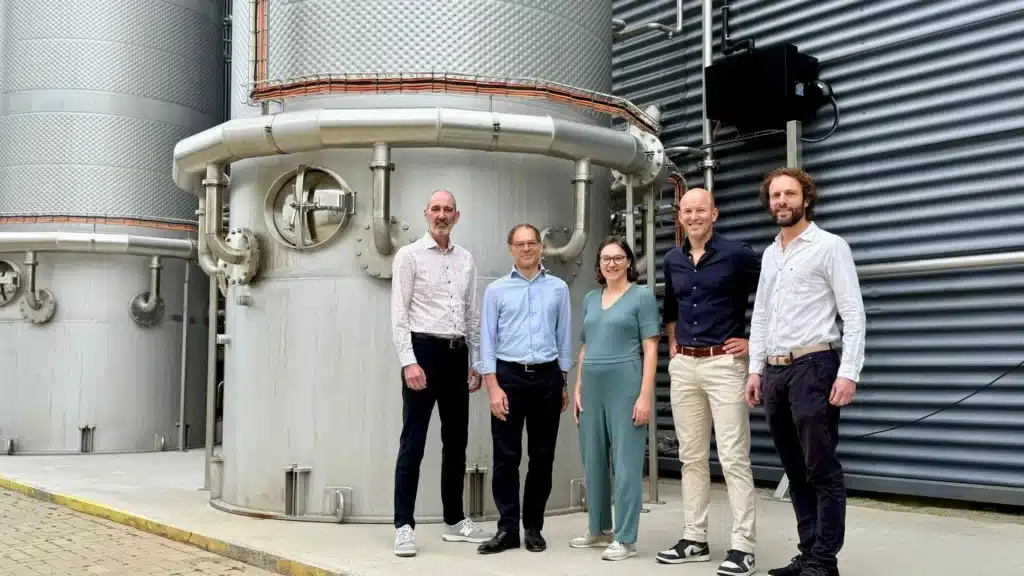
The Protein Brewery management team (left to right): Gilbert Verschelling, Jan Hendrik van Gilst, Yvonne Dommels, Thijs Bosch, Bas Jurgens
Forward Fooding: Let’s finish off with a bang: imagine it’s 10 years from now and your company has fully achieved its original vision. Describe the one headline you would be most proud to read about the impact your company has generated.
Thijs Bosch: Fermotein® Turns 10: The Mycelium Ingredient That Became a Staple in the Diets of a Healthy, Active Aging Generation.
That headline captures the scale of transformation The Protein Brewery is pursuing. It’s all about a whole-food mycelium ingredient becoming as familiar in a breakfast shake or a snack bar as soy or whey, quietly delivering more protein, fiber, and longevity-supporting bioactives to an aging population without demanding dietary overhauls or premium pricing. The steady progression of regulatory clearances, capacity expansions, and partnership pipelines makes that future plausible today.
Request a Fermotein® sample for your formulation: theproteinbrewery.com/sample
To learn more about the FoodTech 500 ranking and global FoodTech ecosystem insights, visit forwardfooding.com/foodtech500.
Are you an AgriFoodTech innovator? Pre-apply for the 8th Edition of the FoodTech 500.
Forward Fooding is the world’s first collaborative platform for the Food & Beverage industry via FoodTech Data Intelligence and Corporate-Startup Collaboration — Learn more about our Consultancy and Scouting Services and our Startup Network.