Welcome to the Forward Fooding FoodTech 500 Sector Spotlight Series, where we go deep on each domain: the data, the science and the companies. After Ag Biotech and Waste to Value, Edition 03 turns to Protein Fermentation.
A newcomer entered the 2025 FoodTech 500 at #3, and it is a fermentation company. MycoTechnology is the highest-ranked first-timer on the entire list, and one of 32 Protein Fermentation finalists, 6.4% of the ranking.
This is also the youngest and most European domain in our series so far. 81% of its finalists were founded in 2020 or later, and 72% are based in Europe, against 54.8% across the full list.
In our 2025 whitepaper, we argued that food is not code: fermentation technologies can take 12 to 15 years to reach commercial viability, far longer than a typical venture fund. These 32 companies show what building on that timeline looks like.
What is protein fermentation?
Fermentation is one process with three very different uses. All three put microbes to work, but what they produce, and how they make money, differs.
| Type | What the microbe does | Example |
|---|---|---|
| Biomass fermentation | The microbe is the food: fungi, yeast or bacteria are grown and harvested as protein | Mycoprotein |
| Precision fermentation | The microbe is programmed to make one specific molecule, which is then separated out | Animal-free whey, egg white, lactoferrin |
| Traditional fermentation | The microbe transforms a food we already know, for taste, texture, or nutrition | Tempeh, koji |
For a closer look at how precision fermentation works, see our explainer Milk Without the Cow. A fourth approach, gas fermentation, makes protein from CO₂ or air, and we covered it in Air + Microbes = Food?
Protein Fermentation sits next to two neighbouring domains on the list. Biotech/Synthetisation (51 finalists) covers broader biomanufacturing of ingredients and enzymes. Cellular Agriculture (28) grows animal cells rather than microbes.
Why it matters more now
Three shifts are pulling fermentation from the lab towards the ingredient list.
- Protein supply that does not depend on land or livestock. Dairy and egg supply chains have shown how exposed they are to disease, weather and feed costs. Fermentation makes the same proteins in a tank, all year round.
- Nutrition is moving to bioactives. Proteins such as lactoferrin and osteopontin, once only available in tiny amounts from milk, can now be made at scale for infant, adult and medical nutrition. We explored this in our lactoferrin deep-dive.
- Fats are under pressure. Palm, coconut and cocoa butter face deforestation rules and price swings. Fermented fats offer a different route, as we set out in The Fat Problem.
Protein Fermentation by the numbers (FDN Numbers)
Protein Fermentation punches above its size. MycoTechnology (#3) and The Protein Brewery (#10) sit in the Top 20, and 9 of the 32 finalists make the Top 50 of the 2025 FoodTech 500. Half the domain has at least one female founder, against 38% across the full list.
It is also the most capital-intensive domain in our series. Only 50% of finalists generate revenue, compared with 80% across the list, 71% for Ag Biotech and 94% for Farm Management & Precision Farming. The median self-reported raise is around $12.3M, almost three times the list-wide $4.5M. That is not a weakness of the companies: scaling microbes, building capacity and clearing regulators simply push revenue later. Funding is concentrated too, with six companies (MycoTechnology, Helaina, Onego Bio, The Protein Brewery, MATR Foods and The Better Meat Co.) holding about 62% of the domain’s ~$848M.
The domain moves fast. Planetary Group climbed from #249 to #133, Melt & Marble from #167 to #85, The Better Meat Co. from #100 to #31 and Verley from #97 to #36. Seven companies are newcomers, led by MycoTechnology and Vivici (#49).
| Metric | Protein Fermentation | Whole list | Note |
|---|---|---|---|
| Finalists | 32 (6.4%) | 500 | 6th-largest domain |
| Countries | 15 | 53 | US 5, Netherlands 4, Germany 4, France 3, Switzerland 3 |
| European finalists | 23 (72%) | 54.8% | Most European domain in the series |
| Early stage (pre-seed, seed) | 16 (50%) | 50.2% | – |
| Series B or later | 5 (16%) | 13.6% | – |
| Revenue-generating | 16 (50%) | 80% | Longer scale-up and regulatory cycles |
| Median raise (self-reported) | ~$12.3M | $4.5M | – |
| Self-reported total funding | ~$848M | $8.4B | Top 6 hold ~62% |
| Female founder(s) | 16 (50%) | 38% | – |
| BAME founder(s) | 5 (16%) | 26% | – |
| Founded 2020 or later | 26 (81%) | – | Median founding year 2021 |
Source: 2025 FT500 Finalists. Whole-list figures from the 2025 Whitepaper. Note: Funding is self-reported by companies.
Applications for the 2026 FoodTech 500 close on Sunday 15 November. More on how to apply at the end of this piece.
The Protein Fermentation Map
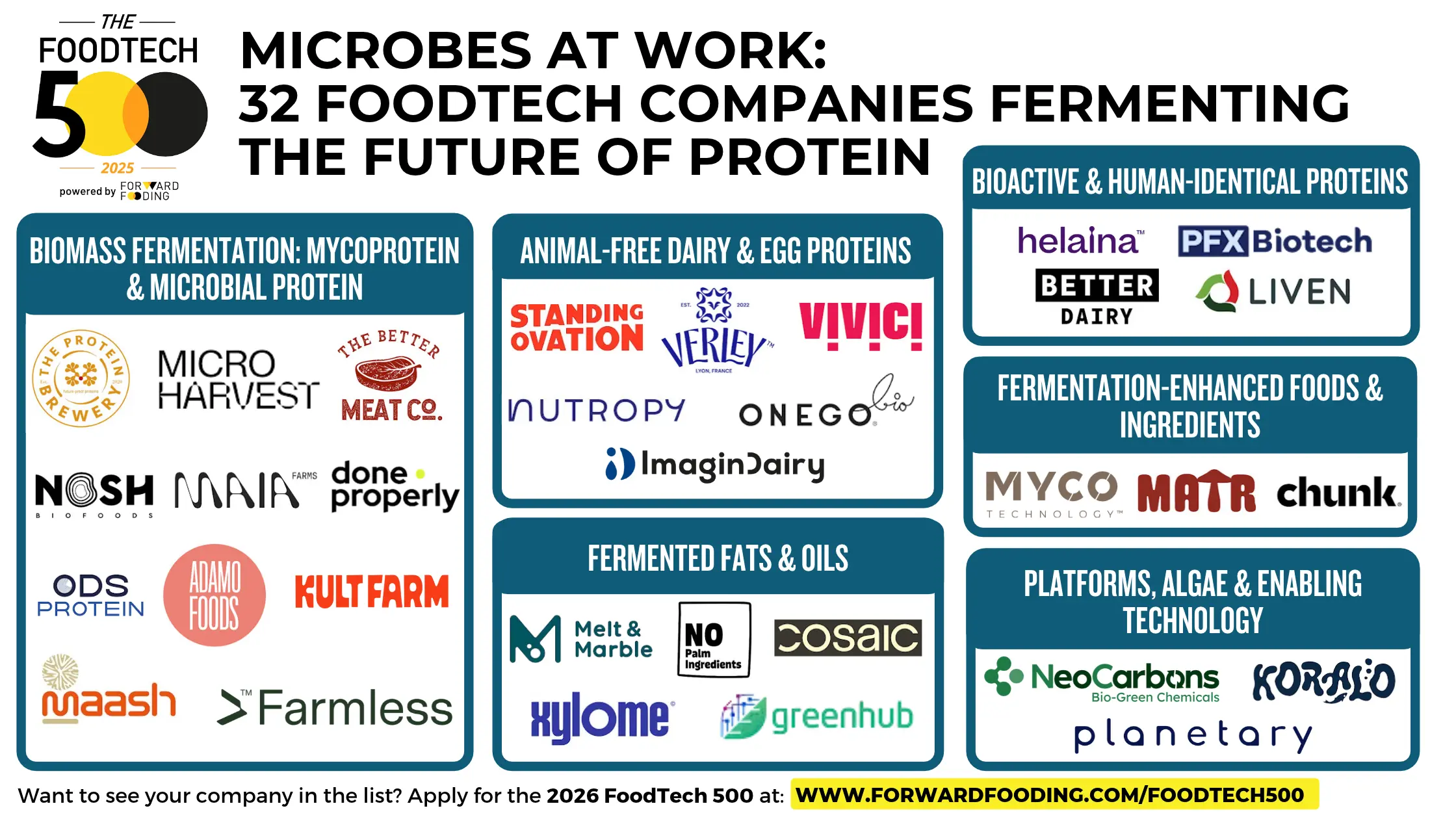
To map the domain, we grouped the 32 finalists by their main technology tag in our FoodTech Data Navigator: Biomass fermentation, Precision fermentation, Oil & Fat analogs and Traditional fermentation. Precision fermentation is the most common tag, so we split it by what it makes: dairy and egg proteins, bioactives and fats. Most companies carry several tags, so each sits under the one that best describes its core technology. The result is six clusters.
Biomass fermentation: mycoprotein & microbial protein (11 finalists)
The largest cluster. These companies grow whole fungi, yeasts, or bacteria as the protein itself, turning sugars or side streams into mycoprotein and microbial protein, mostly sold B2B. It is home to The Protein Brewery (#10), the second-highest-ranked company in the domain.
The Protein Brewery (#10 in the 2025 FoodTech 500) | Netherlands | Grows a nutritious fungal mycelium ingredient through natural biomass fermentation.
MicroHarvest (#29 in the 2025 FoodTech 500) | Germany | Produces protein ingredients from bacteria with a fast, scalable, and resource-efficient fermentation process.
The Better Meat Co. (#31 in the 2025 FoodTech 500) | United States | Manufactures mycoprotein ingredients for food companies.
Nosh.bio (#97 in the 2025 FoodTech 500) | Germany | Uses biomass fermentation of non-GMO mycelium to make affordable, nutritious protein ingredients.
Maia Farms (#247 in the 2025 FoodTech 500) | Canada | Makes clean-label ingredients from oyster mushroom mycelium, from textured proteins to powders.
Done Properly (#265 in the 2025 FoodTech 500) | Chile | Uses fungi and biotechnology to turn industrial by-products into healthier, more sustainable food ingredients.
Adamo Foods (#291 in the 2025 FoodTech 500) | United Kingdom | Uses patented fermentation to make whole-cut alternatives to meat.
ODS Protein (#352 in the 2025 FoodTech 500) | Spain | Ferments filamentous fungi on food-industry by-products to make nutritious protein ingredients.
Kult Farm (fka Esencia Foods) (#385 in the 2025 FoodTech 500) | Germany | Grows a natural alternative to meat through solid-state mycelium fermentation.
Farmless (#436 in the 2025 FoodTech 500) | Netherlands | Grows nutrient-dense functional proteins without the need for agriculture.
MAASH (#495 in the 2025 FoodTech 500) | Belgium | Produces mycoprotein for B2B food manufacturers.
Courtesy: The Protein Brewery
Animal-free dairy & egg proteins (6 finalists)
These companies use precision fermentation to programme microbes to make specific milk and egg proteins, identical to the animal versions, for food manufacturers. It is the cluster most affected by Europe’s regulatory gap, more on that below.
Verley (#36 in the 2025 FoodTech 500) | France | Produces functional dairy proteins through precision fermentation to help the dairy industry cut its footprint.
Standing Ovation (#46 in the 2025 FoodTech 500) | France | Uses precision fermentation to make sustainable, animal-free functional proteins for the food industry.
Vivici (#49 in the 2025 FoodTech 500) | Netherlands | Makes nutritious, sustainable dairy proteins from precision fermentation at commercial scale.
Onego Bio (#54 in the 2025 FoodTech 500) | Finland | Produces egg protein through fermentation as a food ingredient.
Imagindairy (#120 in the 2025 FoodTech 500) | Israel | Uses precision fermentation and AI to make animal-free dairy proteins.
Nutropy (#268 in the 2025 FoodTech 500) | France | Develops animal-free milk ingredients through precision fermentation, with a focus on cheese.
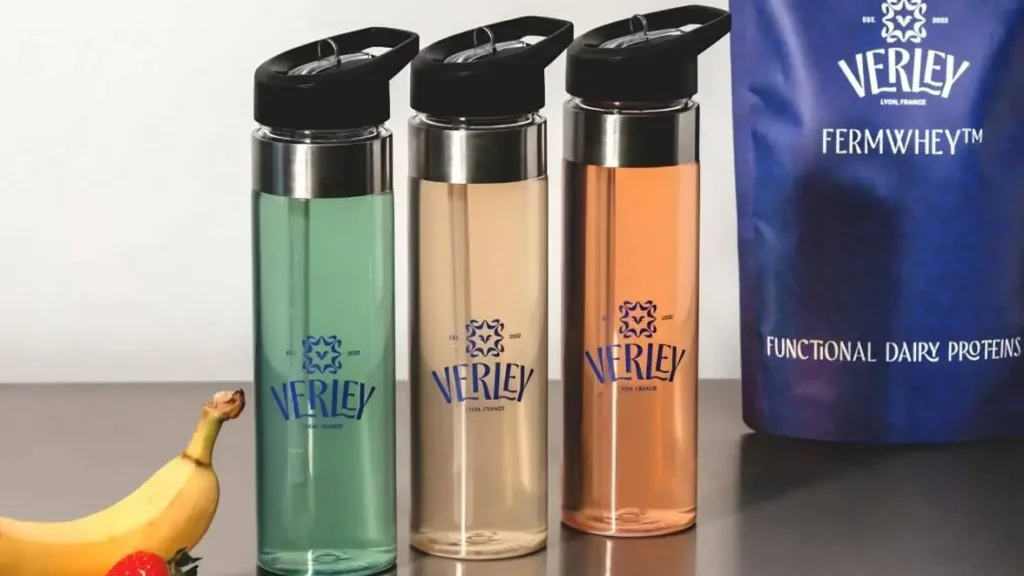
Courtesy: Verley
Fermented fats & oils (5 finalists)
These companies use microbes to make fats and oils that replace palm, coconut, dairy fat and cocoa butter. Melt & Marble (#85) is one of the domain’s biggest climbers, up from #167 in 2024.
Melt & Marble (#85 in the 2025 FoodTech 500) | Sweden | Designs next-generation fats and lipids for food and personal care.
NoPalm Ingredients (#139 in the 2025 FoodTech 500) | Netherlands | Produces sustainable yeast oils and fats by fermenting upcycled agri-food side streams.
Cosaic (#378 in the 2025 FoodTech 500) | Switzerland | Develops a natural, multifunctional emulsion that improves the texture and stability of dairy and dairy-free products.
Xylome (#477 in the 2025 FoodTech 500) | United States | Uses precision fermentation to create sustainable oils.
Green On (#498 in the 2025 FoodTech 500) | Sweden | Makes edible fats and oils without agriculture to replace palm, coconut, dairy fat, cocoa and shea butter.
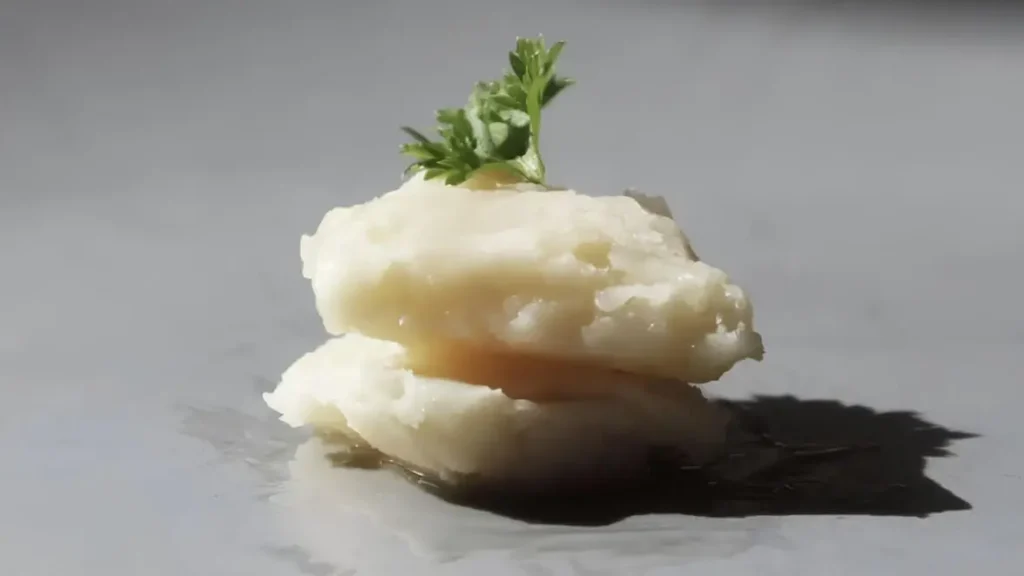
Courtesy: Melt & Marble
Bioactive & human-identical proteins (4 finalists)
These companies make small-volume, high-value proteins such as lactoferrin and osteopontin, often identical to those in human milk, for nutrition and health. High value per kilo makes this one of the most commercially viable corners of precision fermentation today.
Helaina (#39 in the 2025 FoodTech 500) | United States | Designs, manufactures and sells human-identical bioactive proteins.
Better Dairy (#254 in the 2025 FoodTech 500) | United Kingdom | Uses precision fermentation to make human-identical milk proteins such as osteopontin.
PFx Biotech (#347 in the 2025 FoodTech 500) | Portugal | Produces highly bioactive, allergen-free protein ingredients for different life stages through precision fermentation.
Liven (#485 in the 2025 FoodTech 500) | Canada | Uses precision fermentation to create bioactive ingredients that add health benefits to everyday food.

Courtesy: Helaina
Fermentation-enhanced foods & ingredients (3 finalists)
These companies use fermentation to transform familiar raw materials, such as legumes and fungi, into better-tasting, cleaner-label foods and ingredients. It is home to MycoTechnology (#3), whose sweet protein we covered in this piece.
MycoTechnology (#3 in the 2025 FoodTech 500) | United States | Uses fungal fermentation to deliver better-tasting, healthier and sustainable ingredients, including its sweet protein.
MATR Foods (#26 in the 2025 FoodTech 500) | Denmark | Uses natural fermentation to make umami-rich, clean-label plant-based meat with a juicy bite.
Chunk Foods (#53 in the 2025 FoodTech 500) | United States | Makes high-protein, clean-label plant-based whole cuts from eight simple ingredients using natural fermentation.
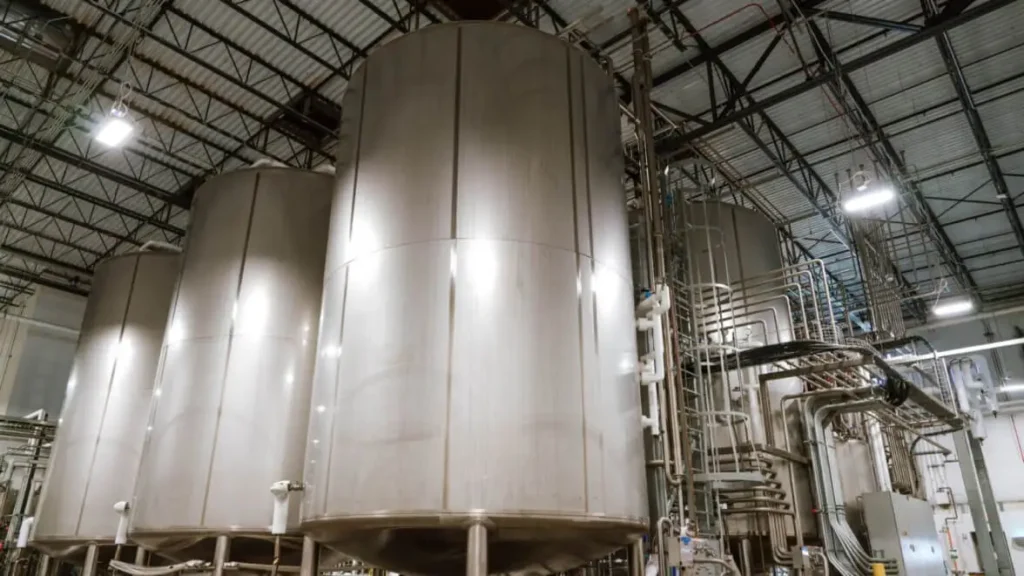
Courtesy: MycoTechnology
Platforms, algae & enabling technology (3 finalists)
These companies sell the means of production: licensed fermentation technology, algae systems and new feedstocks that other producers build on.
Planetary Group (#133 in the 2025 FoodTech 500) | Switzerland | Licenses its BioBlocks industrial fermentation technology to the carbohydrate industry to make bio-based foods and ingredients at scale.
Koralo (#198 in the 2025 FoodTech 500) | Germany | Develops fermentation-based, fish-free ingredients from algae for food and feed.
NeoCarbons (#434 in the 2025 FoodTech 500) | Switzerland | Provides equipment to grow alternative proteins and bioactive chemicals from microalgae.
The picture extends beyond this domain. Other FoodTech 500 finalists also build on fermentation, including Allozymes (#20), Cauldron Ferm (#63), Michroma (#77), Clean Food Group (#200) and Kynda (#216) in Biotech/Synthetisation, plus Protein Distillery and ÄIO from our Food Waste Tech and Upcycling spotlight.
Want to explore these companies and more across fermentation? Find them in the FoodTech Data Navigator.
Why now: the signals for corporates & investors
- Capital has reset, not disappeared. Fermentation companies raised $357M in 2025, down from $632M in 2024, according to the Good Food Institute. But fermentation led alternative protein funding again in Q2 2026, with $132M raised (GFI). The type of money is changing too: MATR Foods (#26) closed a €40M round that included debt from the European Investment Bank.
- Markets outside the EU are moving first. Several precision-fermented proteins are cleared for sale in the US, and Israel now has cow-free milk in shops and cafés, including Strauss Group’s Cow Free milk made with Imagindairy (#120) (DairyReporter).
- Europe is trying to speed up. The proposed EU Biotech Act expands pre-submission guidance from EFSA, the EU’s food safety authority, so applicants know what data they need. Novel foods, however, are left out of its regulatory sandboxes (Food Ingredients First). That matters for a domain where 72% of finalists are European.
- High value comes first. Bioactives such as lactoferrin are commercially attractive today, but extracting it from bovine milk can cost from $600 to $2,000 a kilo (Saudi FoodTech). It explains why the bioactive cluster is small but well funded.
- Demand is growing beyond the plate. Fermented fats and proteins are finding early buyers in personal care and pet food, two markets we explored in our FoodTech-to-beauty and pet food analyses.
Where the caution flags are
Europe’s regulatory gap is real. As of 2026, no precision-fermented dairy or egg protein has received EU novel food authorisation, while several are already cleared in the US (Biosafe). Research suggests applicants should budget 2.5 to 4 years for the process (Trends in Food Science). For the most European domain in our series, that means many companies cannot yet sell their flagship products at home.
Capacity is the bottleneck. Purpose-built, food-grade fermentation capacity is still scarce. Liberation Bioindustries is building a 600,000-litre plant in Indiana, but construction is on pause as it works to raise more funds (AgFunderNews).
Intellectual property is getting expensive. Onego Bio’s lawsuit against The EVERY Company over egg-protein patents was dismissed in October 2026, without a ruling on whether the patent itself is valid (FoodBev). As we explored in Inside the Biggest AgriFoodTech Patent Wars, owning the IP matters as much as owning the science.
Ready to join the 2026 FoodTech 500?
Fermentation is one of the oldest food technologies there is, now doing entirely new work. The 32 finalists show it moving from pilot to product, one ingredient at a time. If your company works in biomass, precision or traditional fermentation, this is the final week: applications for the 2026 FoodTech 500 close on Sunday 15 November 2026. Read what’s new for this year’s edition and apply here.
Forward Fooding is the world’s first collaborative platform for the Food & Beverage industry via FoodTech Data Intelligence and Corporate-Startup Collaboration. Learn more about our Consultancy and Scouting Services and our Startup Network.