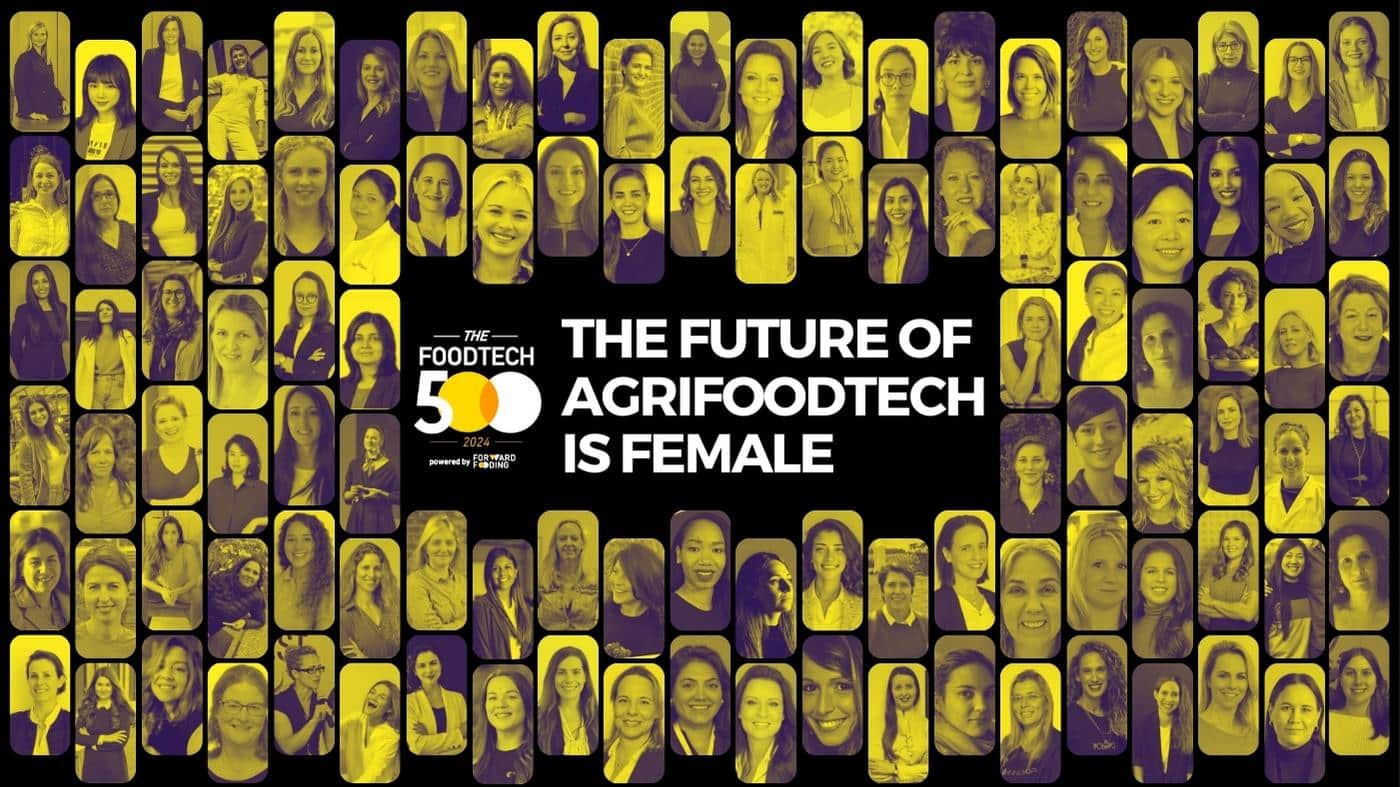
Women’s month may have wrapped, but we at Forward Fooding would still like to shine a spotlight on the remarkable women who are not just participating in the AgriFoodTech revolution but driving it. A 2023 study published in a journal indexed in PubMed Central found that women hold about 26% of leadership roles in the food industry, compared to just 10.9% in the general technology sector.
We also see this trend in the 2024 FoodTech 500 list, which boasts 171 women-founded and/or women-led companies, underscoring their growing influence. Yet, beyond the numbers, it’s about the transformative power they wield, reshaping the future of food with unique perspectives and approaches.
Gaps as Opportunities: Uncharted Territories
While women remain underrepresented, this gap presents a fertile ground for innovation. They’re leveraging their “outsider perspective” to identify overlooked market needs, creating entirely new business models.
As Nélida Leiva Eriksson, Ironic Biotech Founder, notes,
“My own experience with anemia has provided me with invaluable insights into the challenges and shortcomings of existing solutions. I firmly believe that a woman’s perspective is crucial in solving this prevalent issue.”
Meanwhile, Tessa Clarke, Olio Co-founder & CEO, uses her experience as a mother to innovate solutions in the AgriFoodTech space:
“As a woman, and someone who is responsible for feeding my family, I have a particularly acute sense of the value of food, and therefore how big a problem food waste is.”
Malin Bruset, GroGro Founder and CEO, also uses motherhood as her tool in creating invaluable food products:
“For this venture, it’s been a strength to approach the problem first as a mom — and then solve it as a business owner. That dual perspective has helped me build a new and fresh category within kids’ food, rooted in love, compassion, and a deep understanding of what families actually need.”
Monica Bhatia, EQUII Co-founder & Co-CEO, started her company from what she said is “a culmination of my experiences as a woman.
“EQUII was borne out of. During my pregnancy, I faced a constant struggle to get my protein as a vegetarian. The struggle only worsened as my life evolved as a mother trying to source more nutrition into everyday foods that our kids enjoy and, most recently, on the personal front, facing peri-menopause,” she said.
For Maricel Saenz, Compound Foods Founder and CEO, it all comes down to innovating for women’s holistic well-being:
“With Minus, I’ve prioritized functional ingredients that support balanced energy, reducing caffeine dependency, and promoting hormone health.”
Investment Patterns and Success Metrics: Funding the Future
It’s time to move beyond mere representation and examine the how of women’s leadership. Data consistently demonstrates that women-led startups often achieve more with less, showcasing remarkable capital efficiency. Research from BCG indicates women-run startups generate 78 cents in revenue per dollar of funding, compared to 31 cents for male-run startups. Diverse teams, including those with female leadership, also consistently outperform financially.
However, despite their proven success, women founders receive disproportionately less funding. In 2023, only 2% of US startup funding went to women-owned businesses.
Because of this, female founders have to think of creative ways to ensure capital efficiency:
Nélida Leiva Eriksson, Ironic Biotech Founder: “Our approach includes actively seeking equity-free funding, which provides us with the flexibility to explore innovative and high-risk opportunities without compromising our financial commitments.”
Anastasia Gutkevich, Bifidice Founder: “My strategy? Lean teams, scientific partnerships, and ruthless prioritization. I don’t spend on fluff—I spend on what moves us closer to product-market fit and real impact.”
Joëlle van den Brand, Agurotech Co-founder: “I’ve prioritized lean operations, clear priorities, and hiring carefully—only when it truly moves the needle. We also build in close collaboration with customers, which helps us avoid waste and stay aligned with real needs.”
Maricel Saenz, Compound Foods Founder and CEO: “In my case, we’ve focused on lean product development—prioritizing early customer validation before scaling. We also leverage strategic partnerships, particularly in manufacturing and distribution, to optimize costs.”
Sarah Carroll, MariHealth Solutions Co-founder & CEO: “In our early stage, we have placed a strong emphasis on learning and professional development, where (admittedly) we wear multiple hats, which not only saves costs but also creates a richer, growth-oriented culture.”
Agni Hadjilouka, EMBIO Diagnostics Ltd Head of Bioengineering: “By securing EU-funded research grants and industry collaborations, I have been able to accelerate innovation without over-reliance on external investment.”
Malin Bruset, GroGro Founder and CEO: “Most of our marketing has been organic and created in-house to save money.”
The funding disparity is a missed opportunity, as women-owned businesses deliver higher returns on investment. Investors, particularly men, must actively seek and support women-led ventures. Initiatives like the Diversity Rider, championed by funds like Supply Change Capital, are crucial in shifting this landscape.
Overcoming Barriers and Moving Forward
A challenging funding environment is not the only obstacle to the success of female founders. They also have to navigate through gender biases, as well as societal assumptions and prejudices.
Here’s how some AgriFoodTech female founders are overcoming these barriers:
Nélida Leiva Eriksson, Ironic Biotech Founder: “One significant challenge has been conveying the severity of Iron Deficiency and Anemia (IDA) to non-females…. I believe that when addressing a problem that isn’t immediately apparent, it is essential to be resourceful and effectively communicate the issue from the perspective of those involved.”
Anastasia Gutkevich, Bifidice Founder: “The biggest barrier has been being heard. In investor rooms, scientific panels, and even some partnerships, I’ve seen how easily women’s expertise is overlooked—especially in technical domains. To overcome that, I’ve learned to lead with data, with calm authority, and with results that speak louder than opinions. I’ve also had to develop a thicker skin—because you can’t let someone’s lack of imagination limit your ambition.”
Eve Plakk, Paul-Tech Co-founder: “[The] Agriculture [sector] is very conservative and largely owned by large corporations. Just do your own thing, and consistently—even if all the big ones say it’s not possible or not a priority.”
Abir Mehaweyj, BeYou Director and Founder: “There’s often a bias—conscious or not—where women are seen as less capable of building scalable businesses. I also noticed that as women, we tend to be more realistic with our forecasts. We don’t promise dream figures just to impress, and that can be seen as a lack of ambition, when in fact, it’s integrity.
Despite this … I refused to inflate numbers just to fit into an investor pitch mold. Instead, I focused on building real value, proving the concept through traction and partnerships, and letting our progress speak for itself.”
Maricel Saenz, Compound Foods Founder and CEO: “Being underestimated—especially when pitching a company that challenges the traditional coffee and cocoa industries. I’ve learned to embrace these moments as opportunities to prove not only the viability of our business but also the broader consumer shift happening in food and beverage.”
Andrea Araiza Calahorra, MicroLub Technical Director: “One of the biggest challenges has been the representation gap, which makes it harder for women to access the same networks and opportunities as our male counterparts. This gives us fewer opportunities to take on leadership roles in technical fields, which hinders our ability to gain the experience and industry recognition needed to successfully launch and scale a deep tech company.”
Sarah Carroll, MariHealth Solutions Co-founder and CEO: “Being young and female sometimes meant people underestimated my expertise or mistook my approachable nature for naivety. I’ve experienced moments where my contributions weren’t taken seriously or I wasn’t invited into certain ‘men’s club’ conversations at conferences – almost as if I didn’t earn my space at the proverbial table.
I’m gradually learning to build mental defenses, reminding myself why I chose to be here in the first place. I refuse to shy away from speaking up: if my voice isn’t invited to the table, I’ll make sure it’s heard anyway. Whenever I feel overlooked, I return to the core reasons motivating me, using that mission-driven energy to fuel how I respond.”
Agni Hadjilouka, EMBIO Diagnostics Ltd Head of Bioengineering: As a woman in the FoodTech industry, one of the most significant barriers I’ve faced is gaining equal visibility and recognition for my contributions. To overcome this, I’ve focused on collaborating with like-minded colleagues and constantly demonstrating expertise through research and teaching. I also make it a priority to mentor and support other women entering the field, fostering a more inclusive environment for the next generation.”
Hadar Ekhoiz Razmovich, Meala Foodtech Co-founder & CEO: “One of the greatest opportunities I’ve embraced is the chance to exceed expectations—whether in boardrooms, investor pitches, or technical conversations. These moments have strengthened my resolve, allowing me to showcase my credibility and expertise. Instead of feeling discouraged, I’ve used them as motivation to grow. I’ve learned to trust my intuition, support it with data, and build a strong network of mentors and team members who share our vision and recognize the value we bring.”
Maria Fernanda Silva, Bioeutectics Co-founder: “Sometimes, I’ve had to work harder to prove myself and gain trust. To overcome this, I focus on building strong relationships and showing results. I make sure my ideas are backed by data and real-world impact. I also stay confident and persistent, knowing that innovation doesn’t have a gender. Over time, my work speaks for itself.”
Bhavna Tandon, Brown Foods Co-founder: “One of the biggest barriers I’ve faced as a woman in FoodTech is a male-dominated landscape where women representation is fairly limited. I’ve overcome this by building strong networks with fellow female founders, encouraging other female founders, and surrounding myself with a team that shares my vision.”
Silvana Spinelli, Kresko RNAtech Co-founder & CEO: “The biggest challenge has been overcoming imposter syndrome in male-dominated spaces. I’ve tackled it by building a strong network, focusing on achievements, and trusting my unique perspective and skills.”
Beyond “Female Founders”: Transformative Leadership
It goes without saying that leadership diversity fosters creativity and innovation. And women at the helm of any company turn out to have a ton of benefits, as various studies show—from an increase in productivity, enhanced collaboration, inspired dedication, and improved fairness.
When asked about the leadership qualities that have been most crucial to their success in the AgriFoodTech industry, here’s what some 2024 FoodTech 500 female founders have to say:
Riley Jackson, Ivy Farm Technologies Head of Marketing: “The ability to be transparent and honest is essential. The team feels trusted to handle difficult challenges, and they feel included, especially important for start-ups.”
Nélida Leiva Eriksson, Ironic Biotech Founder: “I emphasize personal development and fulfilment, recognizing that many people aspire to have a positive impact on society.”
Joëlle van den Brand, Agurotech Co-founder: “When building teams, I focus on trust, ownership, and open communication, fostering a culture where feedback is valued and everyone feels connected to the bigger purpose.”
Abir Mehaweyj, BeYou Director and Founder: “What matters most to me is the wellness of my team. I actually insist that everyone subscribes to a gym or some kind of physical activity—not just for health, but to protect mental well-being and recharge energy. I truly believe a healthy, balanced team is the foundation for sustainable success.”
Maricel Saenz, Compound Foods Founder and CEO: “At Compound Foods, we cultivate a culture where people feel ownership over their work while also feeling supported. I believe in fostering an environment where curiosity, problem-solving, and well-being are valued as much as performance.”
Andrea Araiza Calahorra, MicroLub Technical Director: “I’ve learned that great leaders are not just experts in their fields, but also listeners and mentors, and good at empowering their teams to bring out their best… I believe that when people feel they belong and are encouraged to contribute their ideas, that’s when true innovation happens.”
Elena Petukhovskaya, Big Akwa CEO: “I don’t believe in standing on the sidelines — I’m in it with the team, solving problems, making decisions, and learning as we go… At the same time, I try to create a culture where people have the space to think independently, experiment, and come up with their own solutions. Innovation doesn’t happen when people are micromanaged — it happens when they feel trusted and supported.”
Jenny Du, Apeel Sciences Senior Vice President: “Practicing humility requires one to be open to the ideas and perspectives of others, to always be open to learning (especially from our inevitable missteps), and to pursue problem-solving with the mindset that it’s more important to be effective than to be “right”.”
Elin Roberts, Better Nature Co-Founder & Co-CEO: “I force myself to take a deep breath and look at the facts in front of me, almost treating it like a puzzle to solve. There’s always a solution – it might not always be pretty, but it’s there, and it’s our job to find it. I find that being calm, rooting things back to our strategy, thinking outside the box, and working well with people help a lot.”
To investors, corporations, and ecosystem builders: Supporting women in FoodTech is not just a moral imperative—it’s a strategic advantage.
To women entrepreneurs: Your unique perspective is your greatest strength. The food system needs your innovations, your resilience, and your vision.
Download the full 2024 FoodTech 500 list here.
Michal Amit, CEO/CTO & Founder at Accellta (#429 in the 2024 FoodTech 500)
Aviaja Riemann-Andersen, CEO and Co-Founder at Agrain (#285 in the 2024 FoodTech 500)
Irene Rupert, Co-Founder at AgrigateOne (#353 in the 2024 FoodTech 500)
Daria Reisch, Co-founder & CEO at Agrinorm (#296 in the 2024 FoodTech 500)
Shobha Chanchlani, Co-Founder & Director at AgriVijay (#111 in the 2024 FoodTech 500)
Débora Campos, Founder & CEO at AgroGrIN Tech (#310 in the 2024 FoodTech 500)
Olga Dubey, Co-founder & CEO at AgroSustain (#263 in the 2024 FoodTech 500)
Martha Montoya, CEO at Agtools (#88 in the 2024 FoodTech 500)
Joëlle van den Brand, Co-Founder at Agurotech (#265 in the 2024 FoodTech 500)
Nemailla Bonturi, Co-Founder at ÄIO (#198 in the 2024 FoodTech 500)
Lena Jüngst, Co-Founder & Co-Inventor at Air Up (#19 in the 2024 FoodTech 500)
Abigail Barnes, Founder & CEO at Amulet (#220 in the 2024 FoodTech 500)
Larissa Viana, CEO at APEXzymes (#491 in the 2024 FoodTech 500)
Brittany Chibe, Co-Founder & CEO at AQUA Cultured Foods (#383 in the 2024 FoodTech 500)
Helga Dögg Flosadóttir, Co-Founder & CEO at Atmonia (#340 in the 2024 FoodTech 500)
Valeria Arredondo, Founder & CEO at BEAM CropTech (#457 in the 2024 FoodTech 500)
Deniz Ficicioglu, Founder & CEO at BettaF!sh (#379 in the 2024 FoodTech 500)
Gali Yarom, Co-Founder & CEO at Better Juice (#208 in the 2024 FoodTech 500)
Elin Roberts, Co-Founder & Co-CEO at Better Nature (#64 in the 2024 FoodTech 500)
Abir Jean Mehawej, Director & Founder at BeYou (#446 in the 2024 FoodTech 500)
Anastasia Gutkevich, Founder & CEO at Bifidice (#481 in the 2024 FoodTech 500)
Elena Petukhovskaya, CEO at BigAkwa AB (#422 in the 2024 FoodTech 500)
Dana Yarden, Co-Founder at BioBetter (#280 in the 2024 FoodTech 500)
Maria Fernanda Silva, Co-Founder & CSO at Bioeutectics (#218 in the 2024 FoodTech 500)
Ximena Adriazola Du Pont, Co-Founder & COO at BNS (#284 in the 2024 FoodTech 500)
Tal Malca Salhuv, Co-Founder & CEO at BOB FoodTech (#378 in the 2024 FoodTech 500)
Ilana Taub, Co-Founder & CEO at Bolder Foods (#471 in the 2024 FoodTech 500)
Hélène Briand, Co-Founder & CTO at Verley/ Bon Vivant (#97 in the 2024 FoodTech 500)
Elena Gross, Founder & CEO at Brain Ritual (#387 in the 2024 FoodTech 500)
Rocio Espinosa Torres, Co-Founder & COO at BYBUG (#360 in the 2024 FoodTech 500)
Shara Ticku, Co-Founder & CEO at C16 Biosciences (#53 in the 2024 FoodTech 500)
Michele Stansfield, Co-Founder & CEO at Cauldron (#67 in the 2024 FoodTech 500)
Hanne Volpin, Co-Founder at Celleste Bio (#108 in the 2024 FoodTech 500)
Heejung Kim, Co-Founder & CTO at