Latin America feeds a large share of the world, and its startups are now working out how to do it with less capital, less waste, and far more scrutiny from investors. In Forward Fooding’s 2025 FoodTech 500 whitepaper, the year was framed as “the Great Correction”: global AgriFoodTech investment is down 70+% from its 2021 peak, and roughly $50 billion in capital has been wiped out across the sector since 2023. Against that backdrop, LATAM founders are appearing in this year’s rankings with models built around problems that already have buyers, from crop biotechnology to insect protein to food waste.
The region’s edge is easy to see once you look at what it has to work with. Vast farmland, rich biodiversity, and long-standing agricultural export economies give LATAM startups a natural testing ground for upstream technologies, which is exactly where global capital has been heading.
What Is LATAM’s Role in the 2025 FoodTech 500?
The FoodTech 500 is Forward Fooding’s flagship ranking of the most innovative startups and scaleups in AgriFoodTech. The 2025 edition drew over 1,200 applications from 87 countries. Of the 500 finalists, 25 companies are headquartered in Latin America, representing 5% of the list, up from 22 companies in 2024.
Those finalists are competing on a tougher scorecard than in earlier years. 96% of this year’s cohort has raised external funding, and 80% are already generating revenue, up from 74% in 2024. The LATAM cohort holds up well. 20 of the 25 finalists are revenue-generating, in line with the global 80%, and 23 have raised external funding. They are headquartered across seven countries (Brazil, Argentina, Chile, Mexico, Colombia, Peru, and Uruguay), and 19 are returning alumni, with six newcomers joining this year. [Insert relevant regional funding context, e.g. access to late-stage capital.]
How Much Funding Is Flowing Into LATAM AgriFoodTech?
According to Forward Fooding’s FoodTech Data Navigator, which now tracks more than 30,000 ecosystem participants worldwide, Latin America is home to 546 AgriFoodTech startups and scaleups. Since 2016, the region has attracted approximately $9.2B in investment, with activity concentrated in Agtech, Food Delivery and Next-gen Food & Drinks (mostly alternative proteins). In 2025, LATAM companies raised $261M, a 52% drop from 2024’s $548M and compared with $3.1B at the 2021 peak.
The global funding picture adds useful context. Worldwide, pre-seed activity has grown to 9.4% of finalists (from 8.2%), while Series A has slipped to 29.4% (from 34.2%) as the so-called Series A crunch bites. Among LATAM finalists, Seed is the most common stage with 10 companies, followed by Series A with 7 and Pre-Seed with 4, plus one Series B company and one grant-funded company.
The domain mix for LATAM’s finalists looks different from the global list. Next-Gen Food & Drinks accounts for 12 of the 25 regional finalists (48%), compared with 23.6% globally, while Agtech makes up 5 (20%), compared with 35.4% worldwide.
Applications for the 2026 FoodTech 500 are open until 15 November. Read until the end to learn how to apply.
Which Countries Lead Latin America’s Food Tech Scene?
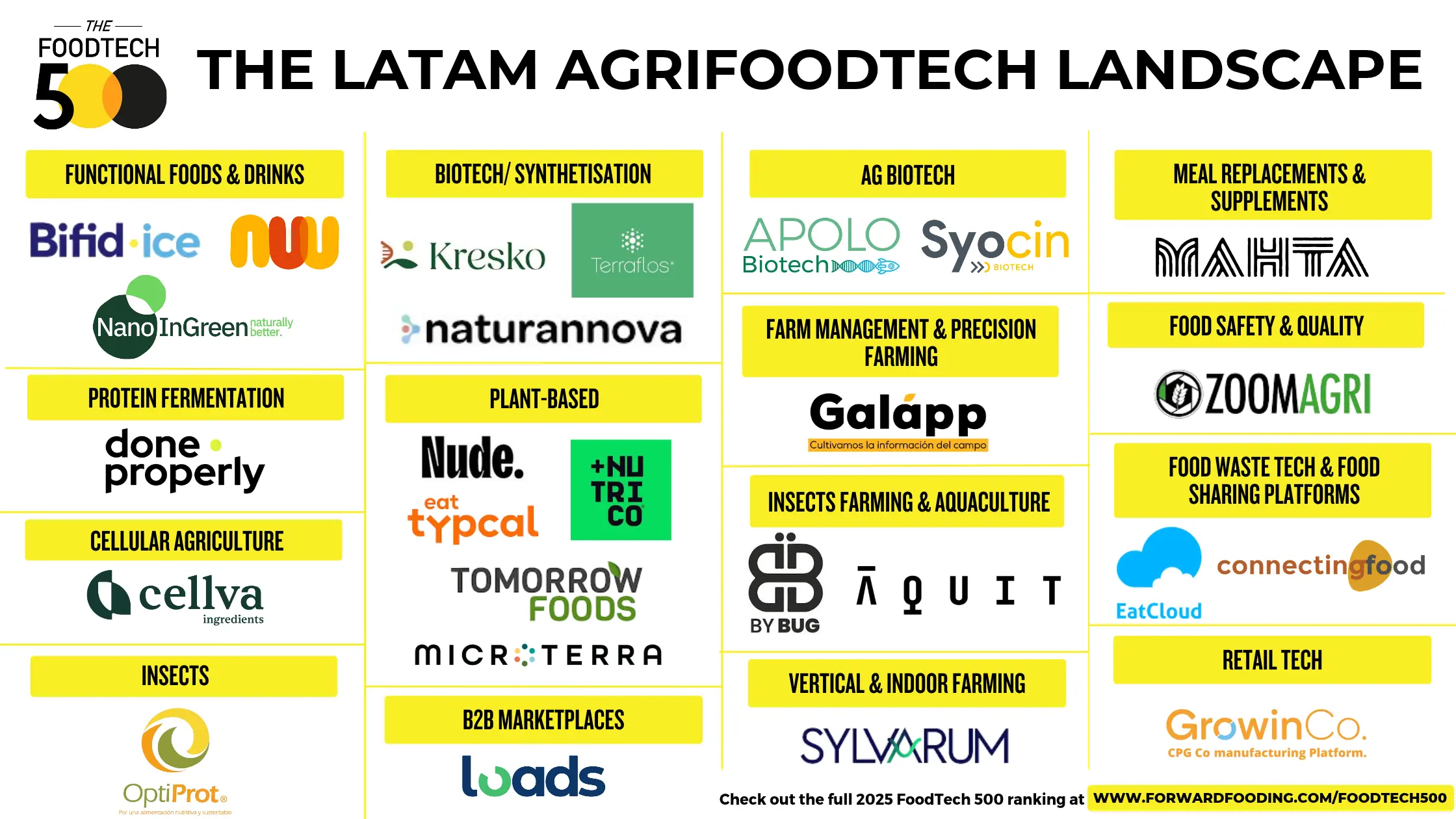
Countries from which the 2025 LATAM finalists hail have established their excellence in various spaces in the AgriFoodTech industry:
Brazil: Data from 2025–2026 confirms that Brazil is a global powerhouse for bioinputs, commanding roughly 50% of the market share in Latin America and recording over R$7B ($1.2–1.3B) in sales. The sector is backed heavily by institutional research giants like Embrapa. Just this month, Brazil was granted its first industrial GMO authorization for biological agricultural inputs, allowing modified microorganisms to act as industrial molecular platforms to produce purified metabolites and phytohormones.
Argentina: It continues to lead global regulatory pioneering for gene-edited crops, treating CRISPR modifications with no foreign DNA under less stringent, conventional-crop rules. Its biotech poster child, Bioceres, continues to scale its climate-resilient, drought-tolerant HB4 wheat to combat environmental volatility. Furthermore, through projects like FONTAGRO, Argentine researchers are leveraging gene editing to alter the plant-microorganism interaction and ruminal microbiomes to mitigate climate change emissions while maintaining high yields.
Chile: Backed by state engines like CORFO, Chilean universities (such as Pontificia Universidad Católica and Universidad de Concepción) operate prominent, specialized marine biotechnology labs. In recent years, companies like SeaBiotech have successfully scaled seaweed-derived agricultural bio-products. In 2026, Chile announced it would host the Fourth International Symposium on Epigenetics in Marine and Aquatic Research (EPIMAR 2027), highlighting its role in applying multi-omic data to aquatic resource management and climate adaptation.
Mexico: Together with Brazil, Mexico captured ~78.5% of all VC funding, as it serves as the definitive hub for downstream commercial scaling, e-commerce, and logistics automation, leveraging its physical proximity to the US market and massive domestic consumer base.
Colombia & Peru: Agtech reports from 2025–2026 show rapid traction in precision farming, mapping diverse microclimates, and managing specialized supply chains, like the AgTech Incofin Project, which expanded specialized digital platforms in these two countries.
Uruguay: The integration of AI-driven livestock tracking has become a multi-million-dollar credit and traceability asset across the Southern Cone. Recent 2026 fintech-agtech crossovers feature operations backed directly by satellite imagery and smart ear-tagged cattle to meet strict international traceability standards.
Meet the LATAM Finalists in the 2025 FoodTech 500
These Latin American companies have secured spots in the 2025 FoodTech 500, showcasing outstanding innovation, growth, and impact within the AgriFoodTech sector:
ZoomAgri (#78 in the 2025 FoodTech 500) | Food Safety & Quality | Uses AI and computer vision to deliver rapid, objective quality and variety analysis for barley, wheat, and soy.
Nutri Co (#79 in the 2025 FoodTech 500) | Plant-based | Uses AI to create nutritious, sustainable, and affordable food products.
Nude. (#87 in the 2025 FoodTech 500) | Plant-based | Makes oat-based products with a focus on innovation and climate transparency.
Terraflos (#88 in the 2025 FoodTech 500) | Biotech/Synthetisation | Develops, produces, and commercializes next-generation bioactive ingredients and wellness products using advanced biotechnology, AI, and sustainable nature-based platforms to improve human health, longevity, and wellbeing.
microTERRA (#127 in the 2025 FoodTech 500) | Plant-based | Harnesses science to craft sustainable ingredients that elevate flavor and texture for the food industry.
APOLO Biotech (#155 in the 2025 FoodTech 500) | Ag Biotech | Develops next-generation RNA-based solutions for crop protection and crop modulation.
Bifidice (#190 in the 2025 FoodTech 500) | Functional Foods & Drinks | Pioneers probiotic ice creams with proven clinical efficacy, combining science with scalable frozen formats.
Tomorrow Foods (#249 in the 2025 FoodTech 500) | Plant-based | Provides regenerative plant-based protein solutions for the food and biotech industries.
Done Properly (#265 in the 2025 FoodTech 500) | Protein Fermentation | Uses biotechnology to transform industrial byproducts into healthier, more sustainable, and delicious food ingredients.
GrowinCo (#280 in the 2025 FoodTech 500) | Retail Tech | Runs a co-manufacturing and sourcing platform that helps CPG brands launch products 40% faster and cut costs by up to 10% through smarter collaboration with manufacturers and suppliers.
Naturannova (#288 in the 2025 FoodTech 500) | Biotech/Synthetisation | Develops plant-based functional peptides that replace sugar and enhance flavor in food.
EatCloud (#300 in the 2025 FoodTech 500) | Food Waste Tech & Food Sharing Platforms | Helps the food ecosystem redistribute unsold food to reduce waste and fight hunger at scale through a data-based business model.
NUU (#303 in the 2025 FoodTech 500) | Functional Foods & Drinks | Aims to prove that it is possible to create products, grow at scale, and regenerate the ecosystem at the same time.
 Image courtesy: Cellva
MAHTA (#308 in the 2025 FoodTech 500) | Meal Replacements & Supplements | Combines food technology with Amazon rainforest biodiversity to deliver nutrient-dense, regenerative products for gut health, supporting local communities and helping keep the rainforest standing.
Kresko RNAtech (#320 in the 2025 FoodTech 500) | Biotech/Synthetisation | Develops natural, science-driven RNA ingredients that turn foods and beverages into functional solutions for better health.
Cellva (#331 in the 2025 FoodTech 500) | Cellular Agriculture | Develops clean-label, microencapsulated ingredient solutions that enhance stability, bioavailability, and functionality, enabling fat reduction, nutrient delivery, and flavor preservation.
Typcal (#379 in the 2025 FoodTech 500) | Plant-based | Uses a rapid mycelium fermentation process to create new ingredients for the food industry.
ByBug (#418 in the 2025 FoodTech 500) | Insects Farming & Aquaculture | Turns Black Soldier Fly larvae into living biofactories that produce therapeutic proteins directly in insect meal, enabling affordable, orally deliverable animal health treatments through feed.
NanoInGreen (#419 in the 2025 FoodTech 500) | Functional Foods & Drinks | Develops natural bioingredients using microorganisms as biofactories, helping food companies respond quickly to new trends and regulations worldwide.
Optiprot (#428 in the 2025 FoodTech 500) | Insects | Brings alternative insect proteins to consumers’ tables.
AQUIT (#437 in the 2025 FoodTech 500) | Insects Farming & Aquaculture | Develops AI-driven biotechnology that enhances animal immunity and replaces antibiotics for safer, more sustainable protein production across animal farming.
ConnectingFood (#450 in the 2025 FoodTech 500) | Food Waste Tech & Food Sharing Platforms | Offers a methodology that helps retailers, restaurants, and industries redirect surplus food to NGOs and people facing hunger, while leading multisector coalitions and advising on public policy.
Galapp (#460 in the 2025 FoodTech 500) | Farm Management & Precision farming | Provides a CRM built for agrichemical companies across Latin America.
Syocin Biotech (#472 in the 2025 FoodTech 500) | Ag Biotech | Uses a synthetic biology and AI-powered protein design platform to rapidly develop high-performance proteins that eliminate bacteria.
Loads (#479 in the 2025 FoodTech 500) | B2B Marketplaces | Integrates food trade, logistics, and embedded finance on one digital platform to simplify and scale global fresh produce and commodity exports.
What’s Next for Latin America’s AgriFoodTech Sector?
The Great Correction has reached Latin America too, and founders in the region are working with tighter budgets than they had a few years ago.
What the region brings to the next phase is a food system rich in raw materials, biodiversity, and real agricultural demand. This year’s LATAM finalists work across plant-based and functional foods, insect and aquaculture protein, biotechnology, precision farming, and food waste platforms, a mix that pairs newer food categories with upstream tools growers can put to use. With four in five finalists already generating revenue, they are running the kind of businesses the market is rewarding right now.
The 25 Latin American companies in the 2025 FoodTech 500 point to a region whose AgriFoodTech sector is growing up quickly. Whether that translates into faster recovery than other regions is still an open question, but the foundations are strong, and the founders on this list are already building on them.
Become a 2026 FoodTech 500 finalist?
Ready to make your mark on the future of food? The Forward Fooding 2026 FoodTech 500 is calling for applications from groundbreaking companies. Discover what’s new in this edition. APPLY NOW!
Forward Fooding is the world’s first collaborative platform for the Food & Beverage industry via FoodTech Data Intelligence and Corporate-Startup Collaboration – Learn more about our Consultancy and Scouting Services and our Startup Network.